Why Am I Not Getting Interview Calls? 10 Reasons and Fixes for Experienced Professionals
Karan Saini · 25 Oct 2026 · Career & Interview Prep
Key Takeaways
- If you have experience but are not getting interview calls, the cause is usually one of a few fixable things: a resume that does not match the role, a stale or poorly worded job portal profile, the wrong applications, or filters like notice period, salary or location.
- Recruiters search their database and job portals with keywords. If your title, skills and recent work do not use the words they type, your profile simply does not show up.
- Applying to many roles with one generic resume is slower than applying to fewer, well-matched roles with a tailored resume.
- Run the 15-minute self-check below to find your own reason, then follow the 14-day plan to fix it.
- Track every application. Without data you cannot tell whether the problem is your resume, your targeting or the market.
"Why am I not getting interview calls?" is one of the most common questions experienced professionals ask, especially after a few weeks of applying with no response. In most cases the answer is not that you lack skills. It is that your resume, your job portal profile or your application pattern is not matching what recruiters search for and shortlist. This guide breaks down the real reasons, shows you how to find yours in 15 minutes, and gives you a 14-day plan to start getting calls again.
It is written for people with roughly 1 to 8 years of experience in India, mostly in IT, product and MNC roles. If you are a fresher, start with our guide on how to get interview calls for freshers instead.
Table of Contents
- Why am I not getting interview calls? The short answer
- 10 reasons experienced professionals don't get calls (and the fix for each)
- A 15-minute self-check to find your reason
- Notice period, salary and career gaps
- A 14-day plan to start getting interview calls
- How My Career Solution helps
- FAQs
Why Am I Not Getting Interview Calls? The Short Answer
Every application goes through a few stages before your phone rings. Your resume is read by software or a recruiter, your profile is compared with the job's must-have skills, the recruiter decides whether you fit the budget, location and joining timeline, and only then do they call. A problem at any one of these stages stops the process, and you never hear why.
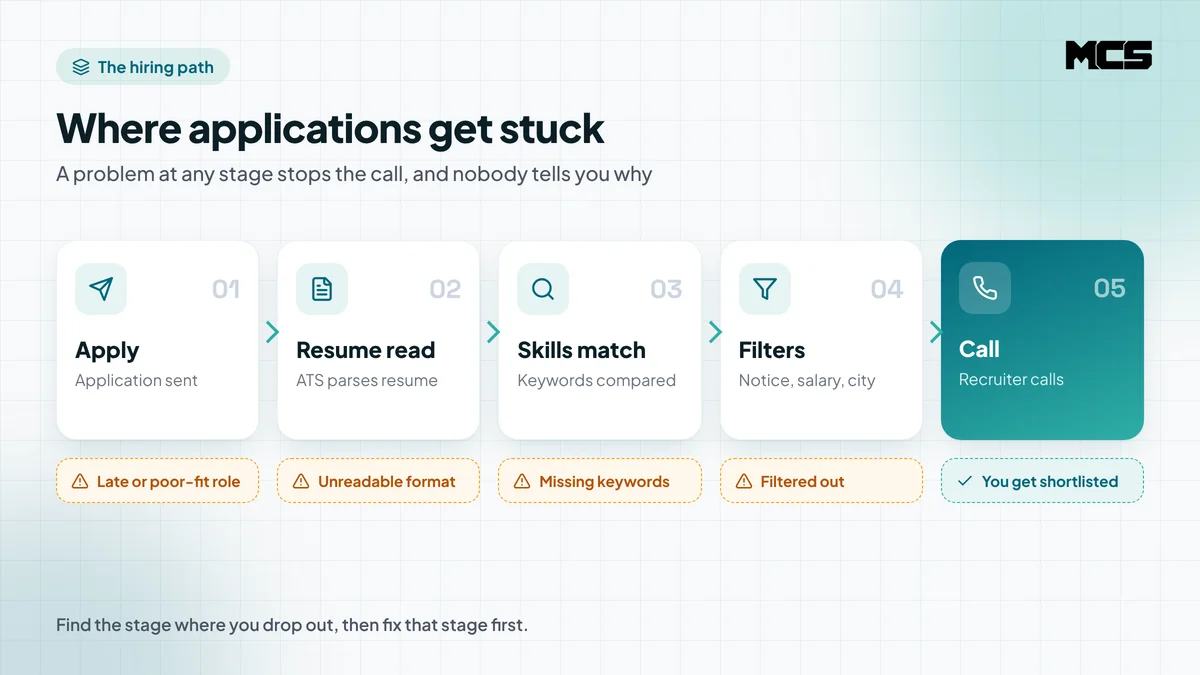
So the useful question is not "why is nobody calling me?" but "at which stage am I getting dropped?" If your resume is not being opened at all, the issue is visibility and keywords. If it is being viewed but you get no call, the issue is fit, filters or how your experience is presented. The sections below help you tell the difference.
10 Reasons Experienced Professionals Don't Get Interview Calls
These are the patterns we see most often when experienced candidates say they are applying a lot and hearing nothing. Most people have two or three of them at the same time.
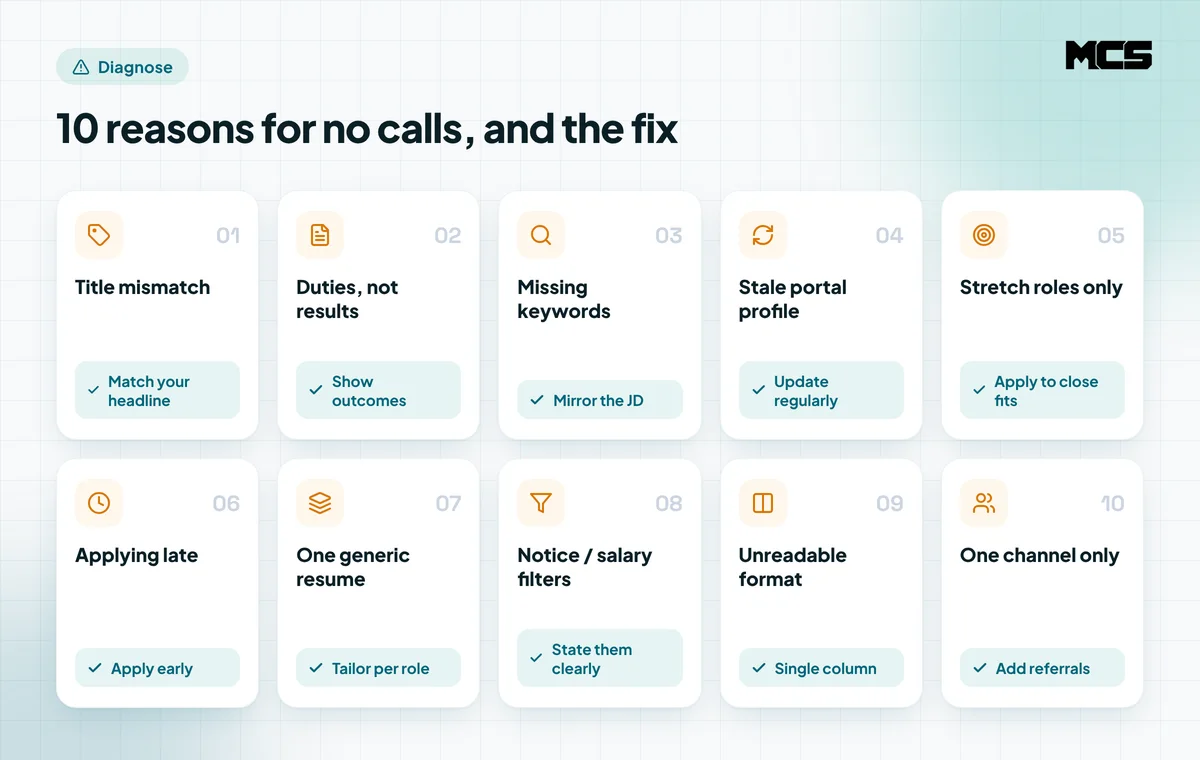
1. Your resume does not match the job title you are applying for
If you apply for "Senior Backend Developer" roles but your resume headline says "Software Engineer - Team Member", a recruiter scanning fifty profiles may not connect the two. Recruiters decide quickly, and they will not dig through your resume to find the match.
Fix: Put the target job title and your total experience at the top, for example "Backend Developer | 4 years | Java, Spring Boot, Microservices". Keep one resume version per role type.
2. Your experience is written as duties, not results
Lines like "Responsible for development and maintenance" tell a recruiter nothing about your level. Two candidates with the same title can look identical on paper unless one shows what they built, improved or owned.
Fix: Rewrite each bullet as action + what you worked on + outcome. For example: "Built a payment retry service in Spring Boot that reduced failed transactions for the checkout flow." Use real numbers only when you know them.
3. Missing keywords from the job description
Recruiters search job portals and Applicant Tracking Systems (ATS) with the exact skills they need: a tool, a framework, a domain. If those words are not on your resume or profile, you do not appear in their results, even if you have the skill.
Fix: Read three or four job descriptions for your target role, list the skills that repeat, and make sure the ones you genuinely have appear in your skills section and inside project bullets. Our ATS friendly resume guide explains the format rules in detail, and they apply to experienced resumes too.
4. Your job portal profile is stale
Many recruiters search portals for candidates before or instead of reading applications. An old profile with an outdated headline, last year's resume and missing key skills gets fewer views.
Fix: Update your headline, key skills, current role, notice period and preferred locations. Upload your latest resume and review the profile regularly so the details stay current.
5. You are applying to roles that are a stretch
Applying for lead roles with three years of experience, or switching domain and level at the same time, usually gets silence. Recruiters shortlist the closest fit first.
Fix: Make most of your applications (around two thirds) roles where you match the experience band and most must-have skills. Keep the rest for stretch roles, and say clearly in your summary why you fit.
6. You apply late
Popular openings collect many applications quickly, and recruiters often start shortlisting from the first batch. If you apply when a posting is weeks old, the shortlist may already be full.
Fix: Check new openings daily and apply soon after they are posted. Browse the latest jobs on My Career Solution and set a fixed time each day for applying.
7. One generic resume for everything
A single resume that tries to cover development, testing and support at once looks unfocused for each of them.
Fix: Keep a base resume and adjust the summary, top skills and the order of bullets for each role family. It takes ten minutes per application and makes a real difference.
8. Notice period, salary or location filters
Many recruiters filter by notice period, current and expected salary, and location before calling anyone. A long notice period or an expected salary far above the role's budget can remove you from the list silently.
Fix: See the section on notice period and salary below.
9. Formatting that software cannot read
Two-column templates, text in images, tables, icons and skill bars can be misread by ATS software, so your name, job titles or skills come out jumbled or missing.
Fix: Use a single-column, text-based PDF or DOCX with standard headings like Summary, Experience, Skills and Education. Copy the text of your PDF into a plain text editor: if it comes out in the right order, it is readable.
10. Applying only through one channel
Depending only on "Easy Apply" buttons means you compete with everyone else who clicked the same button. Referrals, company career pages and direct emails to recruiters often get more attention.
Fix: Mix channels: portals, company career pages, referrals from former colleagues and short, specific emails to hiring teams. Use the companies hiring on My Career Solution to find employers with open roles in your area.
A 15-Minute Self-Check to Find Your Reason
Before changing everything, find out where you are getting stuck. Open your resume, your main job portal profile and a list of your last 20 applications, and answer these questions honestly.
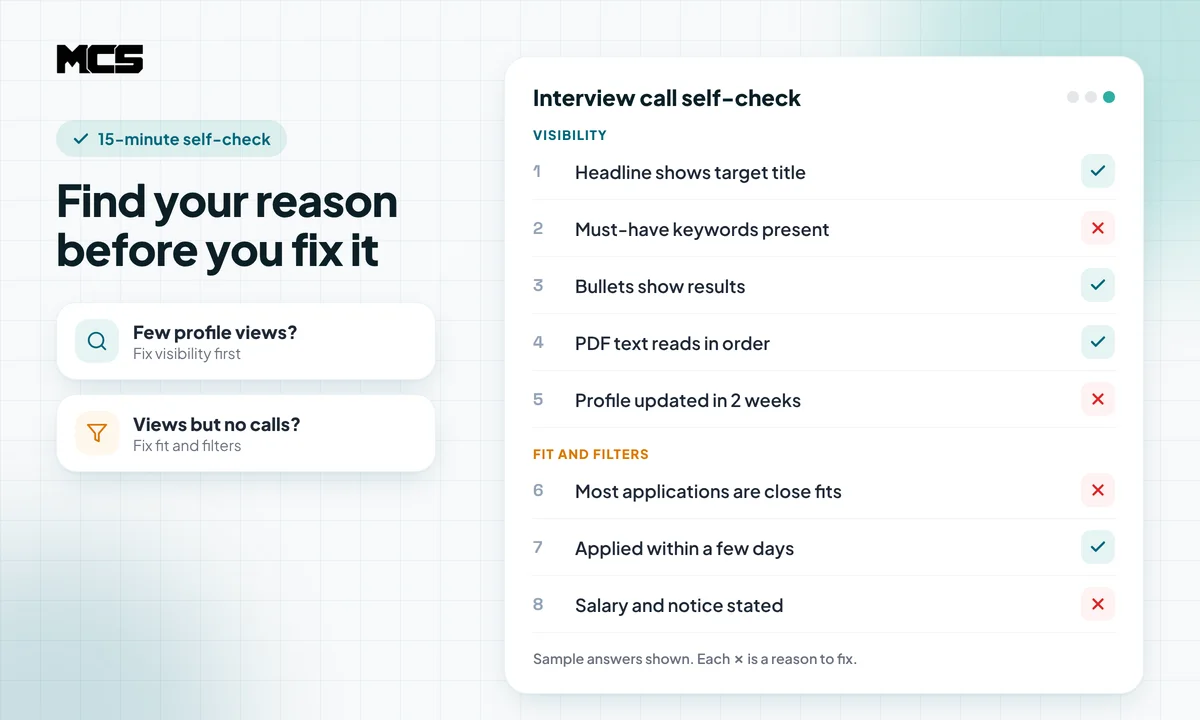
- Headline test: Does the top of your resume show the exact job title you are targeting and your years of experience?
- Keyword test: Pick one job you applied for. Are at least most of its must-have skills written on your resume?
- Results test: Do at least half of your experience bullets show an outcome, not just a duty?
- Readability test: When you copy the PDF text into Notepad, is it in the right order with nothing missing?
- Profile test: Was your job portal profile updated in the last two weeks, with a current resume and notice period?
- Fit test: Out of your last 20 applications, how many matched your experience band and most must-have skills?
- Timing test: How many of those 20 did you apply to within a few days of the posting?
- Filter test: Is your expected salary in the range companies are posting for this role, and is your notice period clearly stated?
If your resume is getting few profile views, focus on tests 1 to 5 (visibility). If views are fine but calls are not coming, focus on tests 6 to 8 (fit and filters).
Notice Period, Salary and Career Gaps: How to Handle Them
These three factors quietly decide many shortlists for experienced candidates.
Notice period
Be accurate. If your company allows early release or buyout, say so in your profile and cover note, for example "60 days, negotiable". If you have already resigned, mention your last working day. Never state a shorter notice period than you actually have; it will come up during the offer stage and can cost you the job.
Expected salary
Look at the salary ranges in postings for your role, city and experience band, and set your expectation within that range. If you are open to discussion, write "as per industry standards" or give a range instead of a single high number. Our guide on finding the right job based on your skills can help you target roles where your level fits.
Career gaps
A short, honest line works better than hiding the gap: "Career break (2025): family responsibility; completed a cloud certification and two personal projects." Show what you did to stay current.
A 14-Day Plan to Start Getting Interview Calls
Here is a simple plan you can follow while you keep working. It moves you from fixing the basics to applying in a focused way, and then measuring what works.
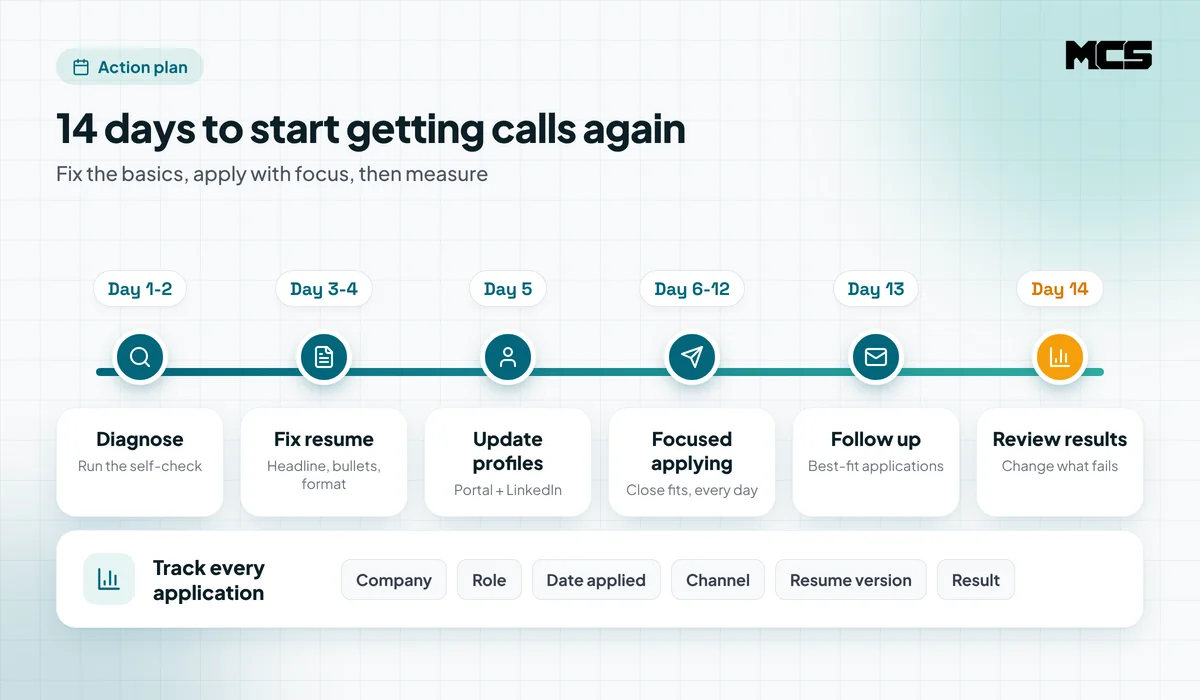
| Days | Focus | What to do |
|---|---|---|
| Day 1-2 | Diagnose | Run the self-check above. Pick your top two or three reasons. |
| Day 3-4 | Resume | Rewrite the headline, summary and experience bullets for one target role. Fix the format. |
| Day 5 | Profiles | Update your job portal and LinkedIn headline, skills, notice period and resume. |
| Day 6-12 | Focused applying | Apply to a small number of well-matched, recently posted roles every day. Tailor the summary and top skills each time. Ask two former colleagues for referrals. |
| Day 13 | Follow up | Send a short follow-up to recruiters or hiring managers for your best-fit applications. |
| Day 14 | Review | Count applications, profile views, replies and calls. Change the one thing that is not working. |
Keep a simple tracker with company, role, date applied, channel, resume version and result. After two weeks you will know whether your problem is visibility, fit or timing, which is much better than guessing.
How My Career Solution Helps
If you do not have time to research companies, tailor resumes and send applications every day, My Career Solution can do much of this for you:
- Free applications on signup: when you sign up, you can send your profile to 5 companies for free from your dashboard.
- Guaranteed interview calls: our paid packages come with a guaranteed number of interview calls based on the package you choose. See the details on the packages page.
- A refined, recruiter-ready resume and personalised applications sent to relevant companies on your behalf, with follow-ups.
- Company and job discovery: browse open jobs and companies with ratings, and read what other users say on our reviews page.
Looking for employers to target first? Our list of top IT companies in India for freshers and experienced professionals is a good starting point. You can find more guides on the MCS blog.
FAQs
Why am I not getting interview calls even with experience?
Usually because your resume or job portal profile does not use the job title and keywords recruiters search for, your experience is written as duties instead of results, or filters such as notice period, expected salary or location remove you from the shortlist. Fixing the top of your resume and applying to closer-fit roles often makes the biggest difference.
How many jobs should I apply to per day?
There is no fixed number. A few well-matched, tailored applications to recently posted roles every day usually work better than dozens of generic ones. Track your results for two weeks and adjust.
Does a long notice period stop interview calls?
It can, because many recruiters filter for candidates who can join soon. State your notice period accurately and mention if it is negotiable, if a buyout is possible, or your last working day if you have already resigned.
Should I update my job portal profile regularly?
Yes. Recruiters search portals for candidates, and an up-to-date profile with a current resume, headline, key skills and notice period is easier for them to find and trust.
Is it a resume problem or a market problem?
Check your profile views and replies. If few recruiters are even viewing your profile, it is usually a visibility or resume problem you can fix. If views are good but calls are rare, look at fit, salary and notice period. Hiring can also slow down in some periods, so keep applying steadily.
Start Getting Interview Calls Again
Not getting interview calls is frustrating, but it is usually a signal that something specific needs fixing, not a verdict on your ability. Run the self-check, fix your top reasons, apply in a focused way and track the results. If you want help, sign up on My Career Solution to send your profile to 5 companies for free, or explore the interview call packages.
Frequently asked questions
Why am I not getting interview calls even with experience?
Usually because your resume or job portal profile does not use the job title and keywords recruiters search for, your experience is written as duties instead of results, or filters such as notice period, expected salary or location remove you from the shortlist. Fixing the top of your resume and applying to closer-fit roles often makes the biggest difference.
How many jobs should I apply to per day?
There is no fixed number. A few well-matched, tailored applications to recently posted roles every day usually work better than dozens of generic ones. Track your results for two weeks and adjust.
Does a long notice period stop interview calls?
It can, because many recruiters filter for candidates who can join soon. State your notice period accurately and mention if it is negotiable, if a buyout is possible, or your last working day if you have already resigned.
Should I update my job portal profile regularly?
Yes. Recruiters search portals for candidates, and an up-to-date profile with a current resume, headline, key skills and notice period is easier for them to find and trust.
Is it a resume problem or a market problem?
Check your profile views and replies. If few recruiters are even viewing your profile, it is usually a visibility or resume problem you can fix. If views are good but calls are rare, look at fit, salary and notice period. Hiring can also slow down in some periods, so keep applying steadily.