How to Identify a Fake Experience Certificate: 9-Step HR Checklist (2026)
Pankaj Gupta · 20 Nov 2026 · Career & Interview Prep
Key Takeaways
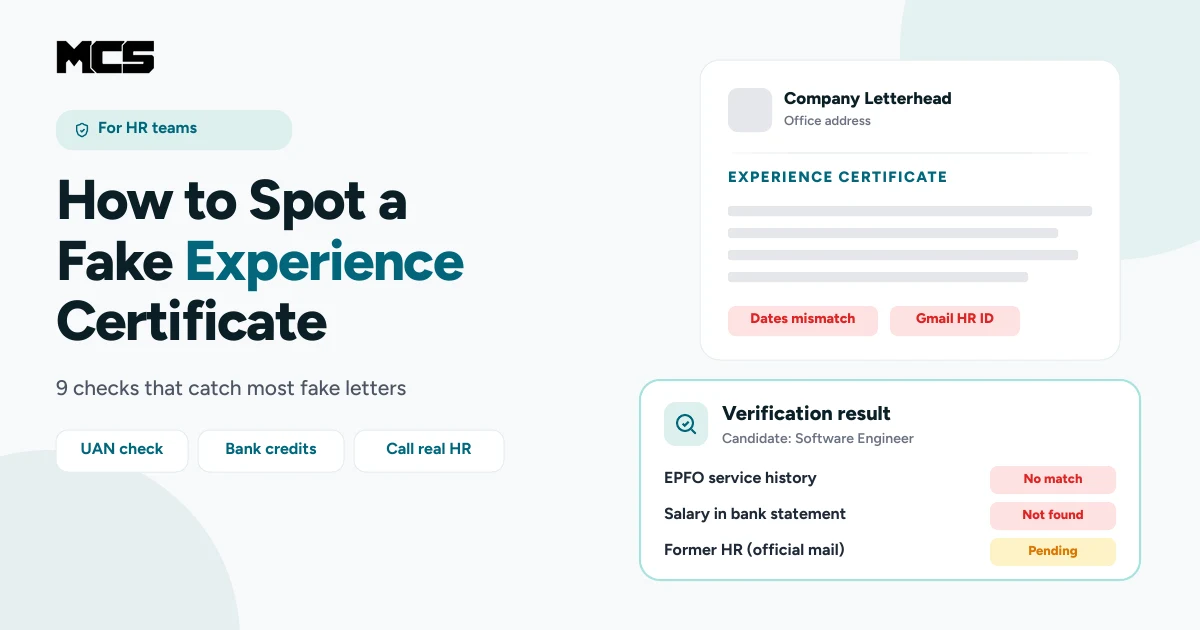
- To identify a fake experience certificate, do not judge the paper alone. Match it against records the candidate cannot easily edit: EPFO service history (UAN), salary credits in the bank statement, Form 16 or Form 26AS, and a call to the former employer's HR through a contact you found yourself.
- Most fake letters fail on simple things: dates that do not match PF records, a company that does not exist, a phone number that goes to a friend, or a "senior developer" who cannot explain their own project.
- Always take written consent from the candidate before any background check, and verify before the offer letter, not after joining.
- A missing PF record alone is not proof of fraud. Small firms, contract roles and some salary levels may not have PF. Ask for other proof before you decide.
- If you find a fake document, pause the process, give the candidate a chance to explain, keep written notes and take a decision as per your company policy.
To identify a fake experience certificate, HR should cross-check the letter with independent records: the candidate's EPFO service history through their UAN, salary credits in bank statements, Form 16 or Form 26AS, and a direct confirmation from the former employer's HR team using a contact you found on your own. If the dates, the company name or the salary do not match these records, treat the letter as suspicious until the candidate proves otherwise.
This guide gives HR teams, founders and hiring managers in India a simple, step-by-step checklist. It covers the red flags on the document itself, the 9 checks that catch most fake letters, a comparison of genuine vs suspicious signs, and what to do when you find a problem. If you are building your hiring process from scratch, also read our guide on reference check questions for HR.
Table of Contents
- Why fake experience certificates are a real hiring risk
- Red flags on the experience letter itself
- How to identify a fake experience certificate: 9-step HR checklist
- Genuine vs suspicious: quick comparison
- What to do if you find a fake certificate
- How to stop fake documents before the offer
- A note for candidates
- How My Career Solution helps
- FAQs
Why Fake Experience Certificates Are a Real Hiring Risk
In India, many job descriptions ask for "2+ years of experience". A fresher who cannot get interview calls may feel pushed to show experience they do not have, and there are agents who openly sell "experience letters with payslips". For an employer, hiring on a fake letter causes problems that go beyond one bad hire:
- Wrong salary band: you pay for experience the person does not have.
- Project risk: the person is placed on client work they cannot handle, and the team has to cover for them.
- Client trust: IT services and staffing companies often have to share verified profiles with clients. One fake profile can hurt the account.
- Unfair to honest candidates: someone who told the truth about their experience lost the seat.
Large IT companies have publicly let go of employees after background checks found forged experience documents, so this is not a rare problem. The good news is that most fake letters are easy to catch if your process checks the right records.
Red Flags on the Experience Letter Itself
Start with the document in your hand. None of these signs prove fraud on their own, but two or three together mean you must dig deeper.
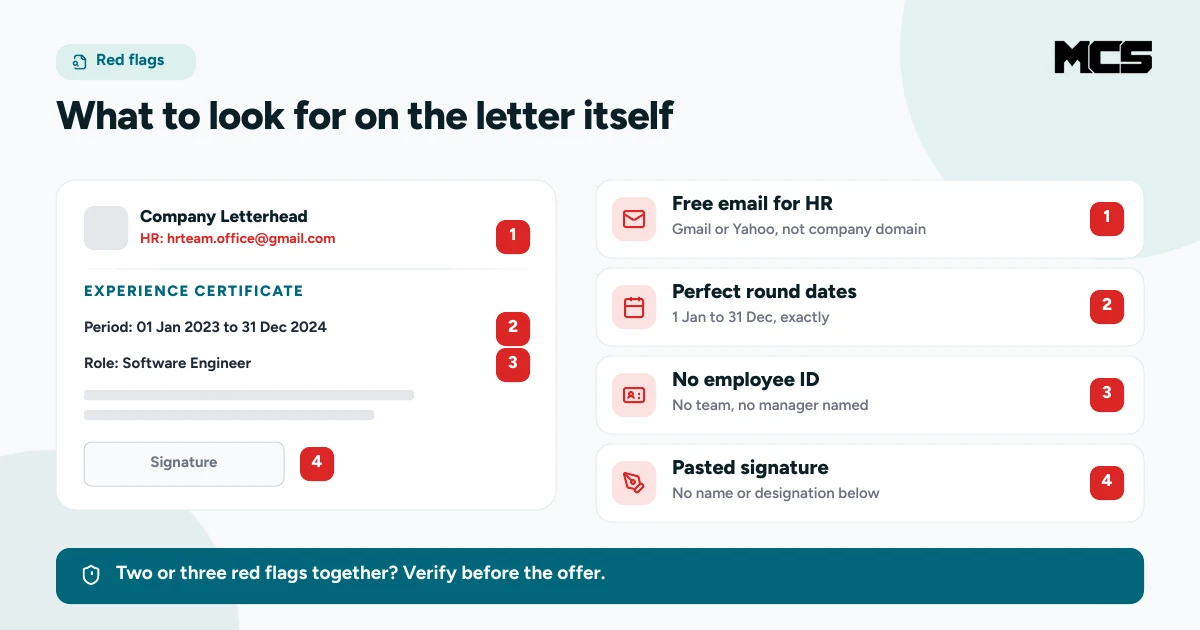
- Generic or free email domain: HR contact like a Gmail or Yahoo ID instead of the company's own domain.
- Only a mobile number: no landline, no website, no full office address.
- Odd letterhead: blurry logo, different fonts in the same letter, address that does not match the company's website.
- Vague role details: "worked as Software Engineer" with no department, no reporting manager and no employee ID.
- Round dates: joined on 1 January, left on 31 December of a later year, exactly. Real dates are usually messy.
- Signature problems: a scanned signature pasted on top, no name or designation under it, or the "HR Manager" signing every letter for every year.
- Spelling and grammar mistakes in the company name, the candidate's name or the designation.
- Company not found: no website, no LinkedIn page, no record on the Ministry of Corporate Affairs (MCA) site.
How to Identify a Fake Experience Certificate: 9-Step HR Checklist
Use these steps in order. The first four are records the candidate cannot easily change, so they catch most fake letters quickly. Take the candidate's written consent before you start.
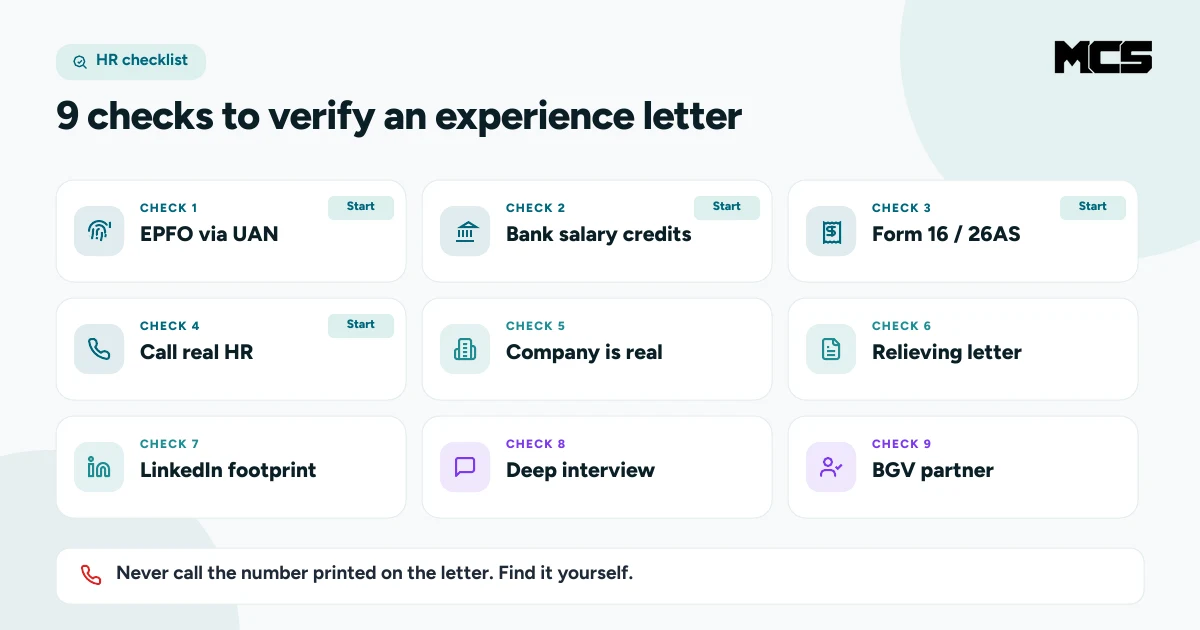
1. Check EPFO service history through the UAN
Ask the candidate for their UAN (Universal Account Number). The candidate can log in to the EPFO member portal and download their service history, which shows each employer that deducted PF and the dates. You can also use a background verification partner that checks UAN records with the candidate's consent. If the letter says "Company A, March 2023 to May 2025" and EPFO shows no Company A, or different dates, ask for an explanation.
Important: PF does not apply to every job. Very small firms, some startups, contract or freelance work and some salary levels may not show in EPFO. A missing record is a reason to ask for other proof, not a final answer.
2. Match payslips with bank statement credits
Payslips are easy to make on a computer. Bank statements are much harder to fake, especially if you ask the candidate to download them in front of you or share them directly from net banking. The monthly salary credit should come from the company's name and match the net pay on the payslips.
3. Look at Form 16 and Form 26AS
If the candidate's salary was taxable, the employer would have deducted TDS. Form 26AS (from the income tax portal) shows TDS deducted by each employer with their TAN. A company that "paid" a salary of several lakhs a year but never shows up in Form 26AS is a red flag.
4. Verify with the former employer, using a contact you found
This is the most important rule: never call the number or email printed on the letter. Fake letters often list a friend's number. Find the company's official HR email or main line from its website, LinkedIn page or MCA record, and ask them to confirm the dates, designation and exit status. Many companies only confirm by email, so be ready to wait a few days.
5. Check that the company is real
Search the company name on the MCA website, check its GST registration if it has one, look for a working website and a LinkedIn page with real employees. Be careful with names that are one letter off from a well-known company.
6. Ask for the relieving letter and offer letter
A real employee usually has an offer letter, appointment letter, salary revision letters and a relieving letter. Check that the dates, CTC and designation are consistent across all of them. Fake kits often have only the experience letter and three payslips.
7. Look at LinkedIn and public footprint
Does the candidate's LinkedIn profile show the same company and dates? Do they have connections who work at that company? A profile created last month with no connections from a "three-year employer" is worth a question.
8. Test the experience in the interview
A person with two years of real work can talk about their team, their manager, the tools, the deployment process, a bug they fixed and a mistake they made. Ask open questions like "Walk me through the last feature you shipped, from ticket to release." Fake experience usually breaks down after two or three follow-up questions. Our list of Java interview questions for 2 years experience shows the depth you can expect from a real 2-year developer.
9. Use a background verification partner for final roles
For senior roles or client-facing projects, a professional background verification (BGV) agency can do address, education and employment checks together. Share only what is needed, take the candidate's consent in writing, and keep the reports secure.
Genuine vs Suspicious: Quick Comparison
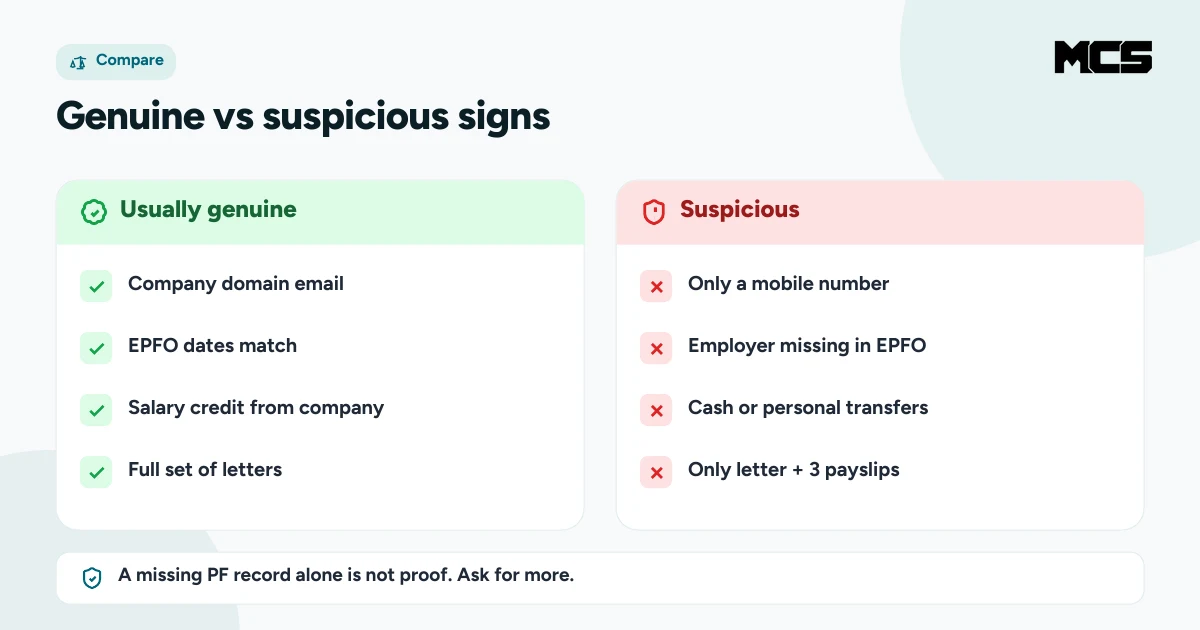
Use this table as a quick reference while screening documents.
| Check | Usually genuine | Suspicious |
|---|---|---|
| HR contact | Company domain email, office landline | Gmail or Yahoo ID, only a mobile number |
| EPFO record | Employer and dates match the letter | Employer missing or dates very different |
| Bank statement | Monthly salary credit from the company | Cash salary, credits from a person's name |
| Form 26AS | TDS from that employer (if salary was taxable) | No TDS for a high stated salary |
| Documents set | Offer, appointment, revision and relieving letters agree | Only an experience letter and a few payslips |
| Company | MCA record, website, real employees on LinkedIn | No website, no MCA record, look-alike name |
| Interview | Specific answers about team, tools and problems | General answers, cannot explain own project |
What to Do If You Find a Fake Certificate
Finding a mismatch is not the end of the process. Handle it fairly and keep records, because the decision may be questioned later.
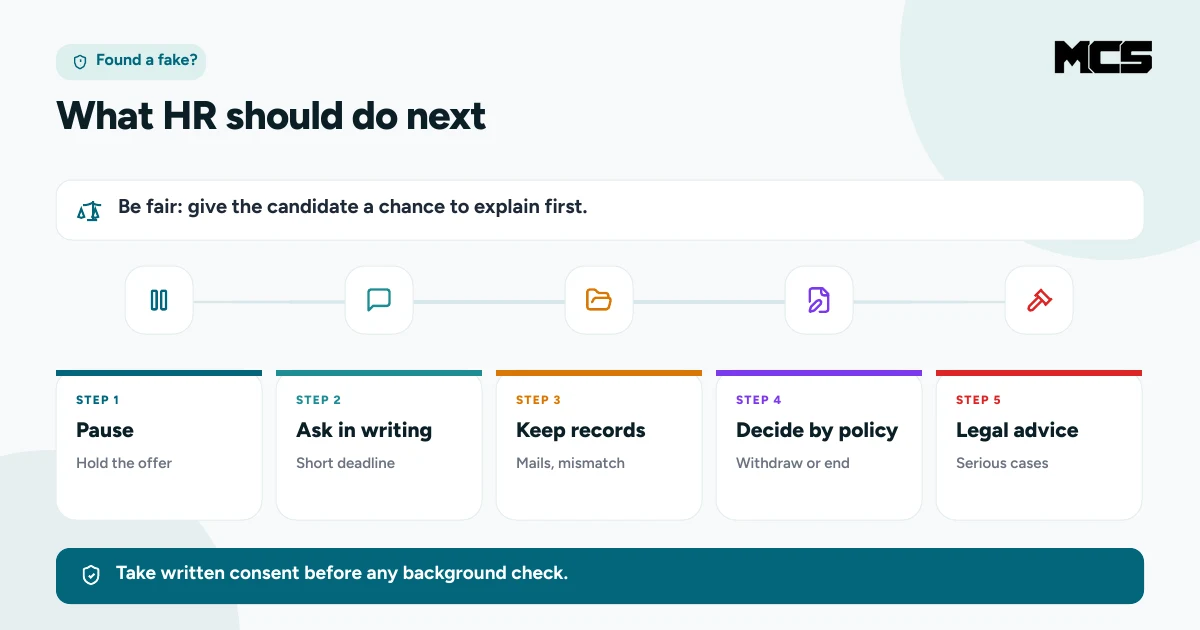
- Pause the process. Do not release or confirm the offer while the check is open.
- Ask the candidate to explain, in writing. There can be honest reasons: the company changed its name, PF was not deducted, or it was a contract role through a vendor. Give them a short deadline to share proof.
- Document everything. Save the letter, your verification emails, the EPFO or bank mismatch and the candidate's reply.
- Decide as per policy. Most companies withdraw the offer before joining, or end employment if the person has already joined, as written in the offer letter terms.
- Take legal advice for serious cases. Making or using a forged document is an offence under Indian criminal law (earlier the IPC, now the Bharatiya Nyaya Sanhita). Whether to file a complaint is a decision for your management and lawyer, not the recruiter alone.
How to Stop Fake Documents Before the Offer
The cheapest fix is a process that makes fake letters hard to use in the first place:
- Declaration in the application form: the candidate confirms that all details are true and agrees that false information can lead to withdrawal of the offer or termination.
- Consent form for background checks signed at the offer stage.
- UAN at the start: ask for the UAN in the first round for experienced roles. Candidates with fake experience often drop out on their own.
- Verify before the offer letter for client-facing and senior roles, and within the first weeks for others.
- Clear job descriptions: if a role is fine for freshers, say so. Asking for "2 years" when you do not need it pushes some people to fake it. Our job description template for software developers shows how to write honest requirements.
- Hire freshers properly: if you have entry-level work, hiring real freshers and training them is cheaper than hiring "fake experienced" people. See how to hire freshers for a startup.
A Note for Candidates: Never Buy a Fake Experience Letter
If you are a job seeker reading this, the message is simple: a fake experience letter is not a shortcut. EPFO, bank and tax records make it easy to catch, often after you have resigned from your current job or moved cities. You can lose the offer, lose the job after joining and face a criminal case.
There are honest ways to compete:
- Apply to roles that are open to freshers. Browse latest jobs and filter by your skills.
- Show internships, projects and freelance work as they really were. A real GitHub project beats a fake title.
- Write a strong resume summary for freshers and follow the steps to get interview calls as a fresher.
- Target companies that hire freshers instead of only "2+ years" roles.
How My Career Solution Helps
For employers and HR teams: you can create an employer account on My Career Solution, post your roles and review candidate profiles with their skills and resumes in one place. Pair it with the checklist above to keep your hiring both fast and safe. Create an employer account.
For job seekers: My Career Solution sends your profile to recruiters at real companies so you do not need shortcuts. When you sign up and complete your profile, you can apply free to 5 matching companies from your dashboard. Our paid packages come with guaranteed interview calls based on the package you choose. See the details on the packages page.
FAQs
How can HR check if an experience certificate is genuine?
Match the letter with independent records: EPFO service history through the candidate's UAN, salary credits in the bank statement, Form 16 or Form 26AS, and a confirmation from the former employer's HR using a contact you found yourself, not the one on the letter.
Can a fake experience certificate be caught through PF?
Yes, in most cases. EPFO service history shows which employers deducted PF and for which dates. If the claimed company is missing or the dates differ, it needs an explanation. But some jobs do not have PF, so a missing record alone is not proof.
Is it a crime to use a fake experience certificate in India?
Yes. Making or using a forged document to get a job can lead to termination and a criminal case for forgery and cheating under Indian law (earlier IPC, now the Bharatiya Nyaya Sanhita). For a specific case, speak to a lawyer.
Can HR verify experience without the candidate's consent?
HR should always take written consent before a background check. Most verification partners will not run checks without it, and consent also protects the company if the decision is challenged later.
What if the old company has shut down?
Ask for other proof: EPFO history, bank statements with salary credits, Form 16, the relieving letter and contacts of former managers or colleagues you can verify on LinkedIn.
Final Word
You do not need expensive tools to identify a fake experience certificate. Check the records that are hard to fake, call the employer through a contact you found yourself, and test real experience in the interview. Build these steps into your process once, and fake letters stop being a problem. Hiring? Start with an employer account. Looking for a job the honest way? See how My Career Solution gets you interview calls.
Frequently asked questions
How can HR check if an experience certificate is genuine?
Match the letter with independent records: EPFO service history through the candidate's UAN, salary credits in the bank statement, Form 16 or Form 26AS, and a confirmation from the former employer's HR using a contact you found yourself, not the one on the letter.
Can a fake experience certificate be caught through PF?
Yes, in most cases. EPFO service history shows which employers deducted PF and for which dates. If the claimed company is missing or the dates differ, it needs an explanation. Some jobs do not have PF, so a missing record alone is not proof.
Is it a crime to use a fake experience certificate in India?
Yes. Making or using a forged document to get a job can lead to termination and a criminal case for forgery and cheating under Indian law (earlier IPC, now the Bharatiya Nyaya Sanhita). For a specific case, speak to a lawyer.
Can HR verify experience without the candidate's consent?
HR should always take written consent before a background check. Most verification partners will not run checks without it, and consent also protects the company if the decision is challenged later.
What if the old company has shut down?
Ask for other proof: EPFO history, bank statements with salary credits, Form 16, the relieving letter and contacts of former managers or colleagues you can verify on LinkedIn.