How to Explain a Career Gap in an Interview (With Sample Answers)
Karan Saini · 23 Nov 2026 · Career & Interview Prep
Key Takeaways
- A career or education gap is common and rarely rejects you by itself. A vague or defensive answer does.
- Use a simple 3-step answer: reason in one line, what you did during the gap, why you are ready now.
- Be honest. Interviewers and background checks can see dates; a made-up story hurts more than the gap.
- Show proof of what you did: a course, a project, freelance work, family responsibility handled, or exam preparation.
- Mention the gap briefly on your resume too, so it is not a surprise in the interview.
Wondering how to explain a career gap in an interview? Give the reason in one honest line, spend most of your answer on what you did and learnt during the gap, and end with why you are ready for this role now. For example: "After graduating I prepared for government exams for a year. During that time I also learnt SQL and Power BI and built two dashboards. I have decided on a data analyst career and I am ready to start immediately."
This guide gives you the 3-step formula, sample answers for the most common gap reasons, how to show the gap on your resume and the mistakes to avoid. It works for fresher education gaps and for gaps after a job.
Table of Contents
- Why do interviewers ask about gaps?
- How to explain a career gap in an interview: the 3-step formula
- Sample answers by reason
- How to show a gap on your resume
- Mistakes to avoid
- How My Career Solution helps
- FAQs
Why do interviewers ask about gaps?
Interviewers are not trying to catch you out. They want to know three things:
- Are your skills still current? Especially in tech, a year away can mean new tools.
- Are you committed now? Will you leave again soon for the same reason?
- Are you honest? How you talk about the gap tells them how you handle tough questions.
Answer those three worries and the gap stops mattering.
How to explain a career gap in an interview: the 3-step formula
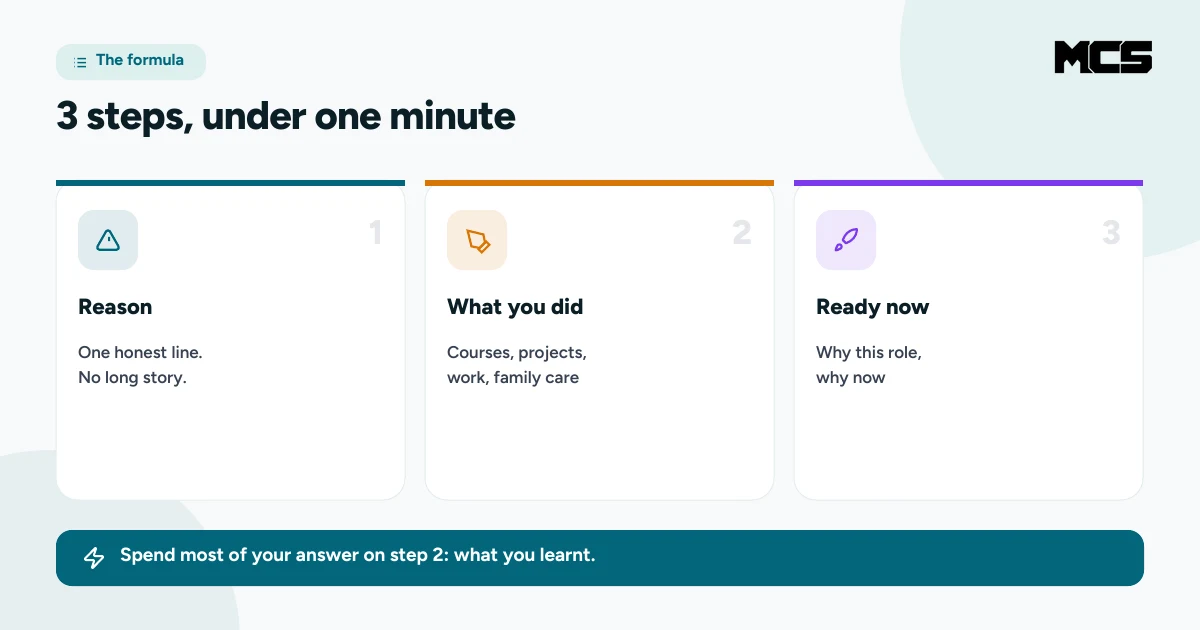
- Reason (one line): say why the gap happened, simply and without over-explaining. "I was preparing for UPSC", "I took care of my father after his surgery", "My company shut down the project".
- What you did (most of the answer): courses, projects, certifications, freelance or part-time work, family responsibilities handled, anything that kept you learning.
- Why you are ready now: the reason has ended or is managed, and you have chosen this role on purpose.
Keep the whole answer to 45-60 seconds. Then stop and let the interviewer ask more if they want.
Sample answers by reason
Use these as structure. Replace every detail with your own real ones.
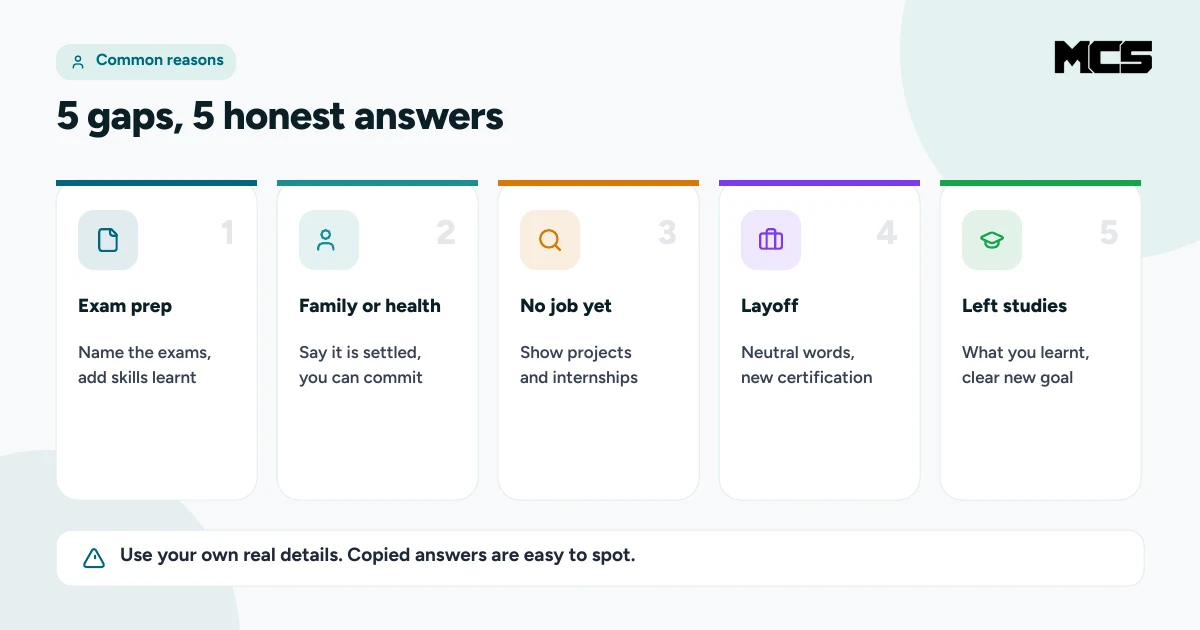
1. Preparing for government or competitive exams
"After my B.Tech, I prepared for SSC and bank exams for about a year. It improved my aptitude and discipline, and alongside I completed a Java course and built a small library management project. I have now decided to build my career in software development, and this role matches the skills I have been working on."
2. Family or health reasons
"I took eight months off to take care of my mother during her treatment. She has recovered now and our family support is in place, so I can commit fully to work. During that time I kept my skills fresh with an online SQL course and practised on two datasets."
3. Did not get a job after graduation
"Campus placements did not work out for me, so I used the time to fill my skill gaps. I learnt React, built three projects that are on my GitHub and did a two-month internship. I am now applying for frontend roles where I can use these skills from day one."
4. Layoff or company shutdown
"My project was closed when the company restructured, and my role was affected along with the team. Since then I have completed an AWS certification and done a freelance website for a local business. I am looking for a stable backend role, which is why this opening interests me."
5. Higher studies that did not work out
"I joined an M.Tech but realised I wanted hands-on industry work, so I left after the first year. The coursework in data structures and databases helped me, and I have since built two projects using them. I am clear now that I want a developer role."
How to show a gap on your resume
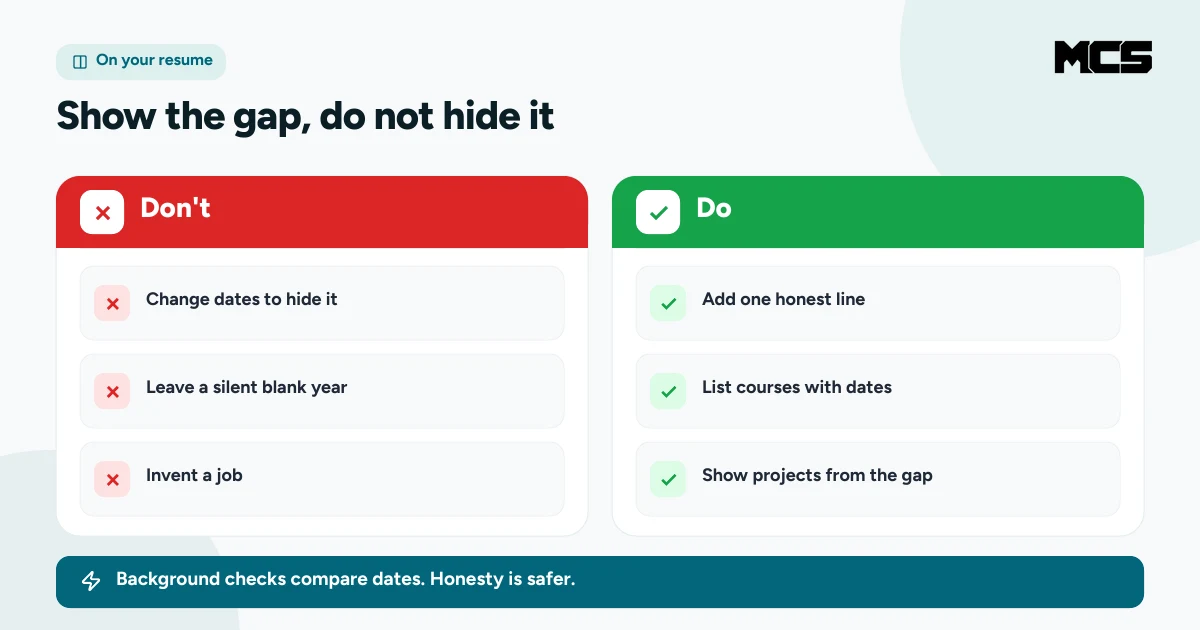
- Do not hide it with wrong dates. Background checks compare dates.
- Add a one-line entry for long gaps, for example: "Career break, Jun 2025 - Mar 2026: family care; completed SQL and Power BI courses."
- List courses and projects done during the gap with dates, so recruiters see you kept learning.
- Use a short summary at the top that points to your target role. Our resume summary for freshers guide shows how.
- Keep the format clean and keyword-matched with our ATS-friendly resume guide.
Mistakes to avoid
- Lying or inventing a job. It can be found in background or reference checks, and it can cost you the offer.
- Over-explaining. A two-minute story makes a small gap sound like a big problem.
- Blaming others. Do not criticise a past employer or family. Keep it neutral.
- Sounding unsure. "I don't know, I was just at home" invites doubt. Talk about what you learnt.
- Ignoring the question in written forms. If an application asks about gaps, answer it in one or two clear lines.
The gap question usually comes along with other HR questions. Prepare them together with our guides to HR interview questions for freshers and tell me about yourself.
How My Career Solution helps
After a gap, the hardest part is often getting the first few interview calls. My Career Solution refines your resume and sends it to the hiring decision-makers at companies that match your profile.
- Sign up and complete your profile, and your resume goes free to 5 matching companies.
- Our packages offer guaranteed interview calls based on the package you choose. See the packages page.
- Browse current openings on the jobs page, and read how to get interview calls for more tips.
Frequently Asked Questions
Is a one-year gap a problem for freshers?
Usually not, if you can show what you did during it. Many freshers have a gap for exam preparation, family reasons or job search. A clear, honest answer and some proof of learning are enough for most employers.
Should I mention my career gap before the interviewer asks?
Show it briefly on your resume. In the interview, you do not need to bring it up first, but answer confidently when asked.
How do I explain a gap due to government exam preparation?
Say it honestly in one line, mention any skills or courses you added during that time, and explain clearly why you have now chosen a private-sector career.
Can a background check find my career gap?
Yes. Background checks and reference checks compare your employment and education dates, so never change dates to hide a gap.
What should I not say about my career gap?
Avoid lying, blaming a past employer or family, giving very personal details, or saying you did nothing. Focus on what you learnt and why you are ready now.
Ready to restart your job search? Choose a My Career Solution package or sign up free to get your first 5 applications sent.
Frequently asked questions
Is a one-year gap a problem for freshers?
Usually not, if you can show what you did during it. Many freshers have a gap for exam preparation, family reasons or job search. A clear, honest answer and some proof of learning are enough for most employers.
Should I mention my career gap before the interviewer asks?
Show it briefly on your resume. In the interview, you do not need to bring it up first, but answer confidently when asked.
How do I explain a gap due to government exam preparation?
Say it honestly in one line, mention any skills or courses you added during that time, and explain clearly why you have now chosen a private-sector career.
Can a background check find my career gap?
Yes. Background checks and reference checks compare your employment and education dates, so never change dates to hide a gap.
What should I not say about my career gap?
Avoid lying, blaming a past employer or family, giving very personal details, or saying you did nothing. Focus on what you learnt and why you are ready now.