How to Negotiate Salary as a Fresher: Scripts, Email Template and What You Can Ask For
Jyoti · 19 Nov 2026 · Career & Interview Prep
Key Takeaways
- Yes, you can negotiate salary as a fresher, but how much depends on the type of hiring. Mass-hiring packages at large IT companies are usually fixed; startups and small companies often have some room.
- Talk about money after the company shows it wants you, ideally after the final round or when the offer is discussed.
- When HR asks your expected CTC, give a researched range, not a single low number, and link it to your skills, projects or internships.
- If the base salary is fixed, you can still ask about joining date, location, joining bonus, relocation help or a review after six months.
- Always compare offers by monthly in-hand pay, not only by yearly CTC. Be polite, put the final terms in writing and never accept an offer that asks you to pay money.
To negotiate salary as a fresher, first research the normal pay for your role and city, wait until the company shows interest, then share a polite, researched range linked to your skills and projects. If the salary is fixed (as in most mass hiring), negotiate other things such as joining date, location or a joining bonus instead.
Many freshers in India accept the first number HR says because they fear losing the offer. A polite, well-prepared request almost never makes a company take back an offer. This guide gives you the right timing, ready HR call scripts, an email template, what you can and cannot negotiate, and mistakes to avoid.
Table of Contents
- Can a Fresher Negotiate Salary in India?
- CTC vs In-Hand Salary: Understand This First
- How to Research the Right Salary for Your Role
- When to Talk About Salary
- How to Answer "What Is Your Expected CTC?"
- What Can a Fresher Negotiate Besides Salary?
- How to Negotiate Salary as a Fresher: Call Script and Email Template
- Salary Negotiation Mistakes Freshers Make
- 6-Step Salary Negotiation Checklist for Freshers
- How My Career Solution Helps
- FAQs
Can a Fresher Negotiate Salary in India?
Yes, but the room to negotiate depends on how you are hired.
- Mass hiring at large IT service companies: thousands of freshers get the same package for the same role. The base salary is usually fixed and not open to negotiation. Asking for more here rarely works and can delay your process.
- Campus placements with a fixed CTC: the package is set in advance with the college. You usually cannot change the base salary, but sometimes you can ask about the joining date or location.
- Startups, product companies and small or mid-size firms: they hire one or a few freshers at a time and often have a salary band, not one fixed number. Here a polite, well-supported request has a real chance.
- Off-campus offers for skilled roles: if you have strong projects, internships or certifications that match the job, you have more to negotiate with.
So the first step is to understand which type of offer you have. Do not argue over a mass-hiring package, but do not stay silent when a smaller company asks what you expect.
CTC vs In-Hand Salary: Understand This First
CTC (Cost to Company) is everything the company spends on you in a year. In-hand salary is what reaches your bank account each month. The two can be very different, and many freshers only find out after joining.
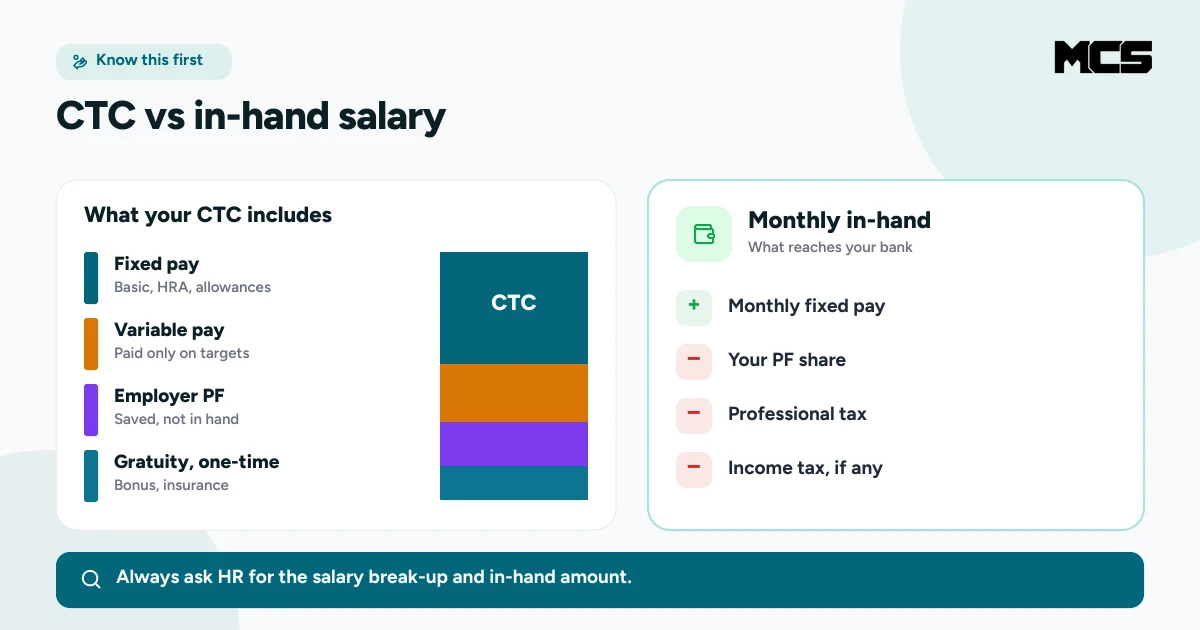
CTC can include:
- Fixed pay: basic salary, HRA and allowances. This is the part you get every month.
- Variable pay or performance bonus: paid only if you and the company meet targets. It may be paid yearly or quarterly.
- Employer PF contribution and gratuity: part of your CTC, but it does not come to your bank account every month.
- One-time items: joining bonus, relocation help or insurance, sometimes counted inside CTC.
From the monthly fixed pay, deductions like your own PF contribution, professional tax and income tax (if your income is above the tax limit) are subtracted. Always ask HR: "Could you share the monthly in-hand amount and the salary break-up?" A slightly lower CTC with more fixed pay can be better than a higher CTC with a large variable part.
How to Research the Right Salary for Your Role
You cannot negotiate without a number, and you cannot pick a number without research. Spend one hour on this before any HR call.
- Salary websites: check AmbitionBox, Glassdoor and LinkedIn Salary for the company, the role and your city. Look at fresher or 0-1 year data, not the overall average.
- Job posts: many job posts show a salary range. Note the range for 10-15 similar fresher roles in your city on MCS jobs and other portals.
- Seniors and friends: ask college seniors who joined similar companies in the last year what they were offered and what the in-hand amount was.
- Our salary guides: see software engineer fresher salary in India and data analyst fresher salary in India for commonly reported ranges by company type, with sources.
From this research, set three numbers for yourself: the lowest amount you will accept (your walk-away point), a fair target, and a slightly higher number to start your range with.
When to Talk About Salary
The best time to negotiate is after the company has decided it wants you and before you accept the offer. At that point, they have already spent time on interviews and want to close the hire.
- Application form or first HR call: if a form or HR asks for expected CTC early, give a range and say it depends on the full role (see the script below).
- After the final round: this is the main moment. HR often calls to discuss the offer. Ask for the break-up and then share your request.
- After the written offer: you can still ask politely within a day or two, but do it before signing. After you accept, reopening salary looks bad.
How to Answer "What Is Your Expected CTC?"
This is the question freshers fear most. Here is how to handle it without under-selling yourself.
If it comes early (before you know the role well):
"I'd like to understand the role and the responsibilities a little more before I give an exact number. For fresher roles like this in [city], I've seen offers around [₹X to ₹Y LPA], and I'm open to a fair offer within that range."
If it comes after the final round:
"Thank you, I'm really excited about this role. Based on my research for [role] in [city], and my [internship / project / certification], I was expecting something in the range of [₹X to ₹Y LPA]. Is there flexibility to reach that?"
Tips:
- Give a range where the lower end is a number you will be happy with.
- Link your number to something real: an internship, a project that matches their work, a certification or a strong coding profile.
- Do not quote a friend's offer from a very different company as your reason.
- If HR says the salary is fixed for all freshers, accept that gracefully and move to non-salary items.
For other HR questions that come up in the same call, read our HR interview questions for freshers.
What Can a Fresher Negotiate Besides Salary?
When the base salary is fixed, many other parts of the offer may still be open. These matter a lot in your first job.
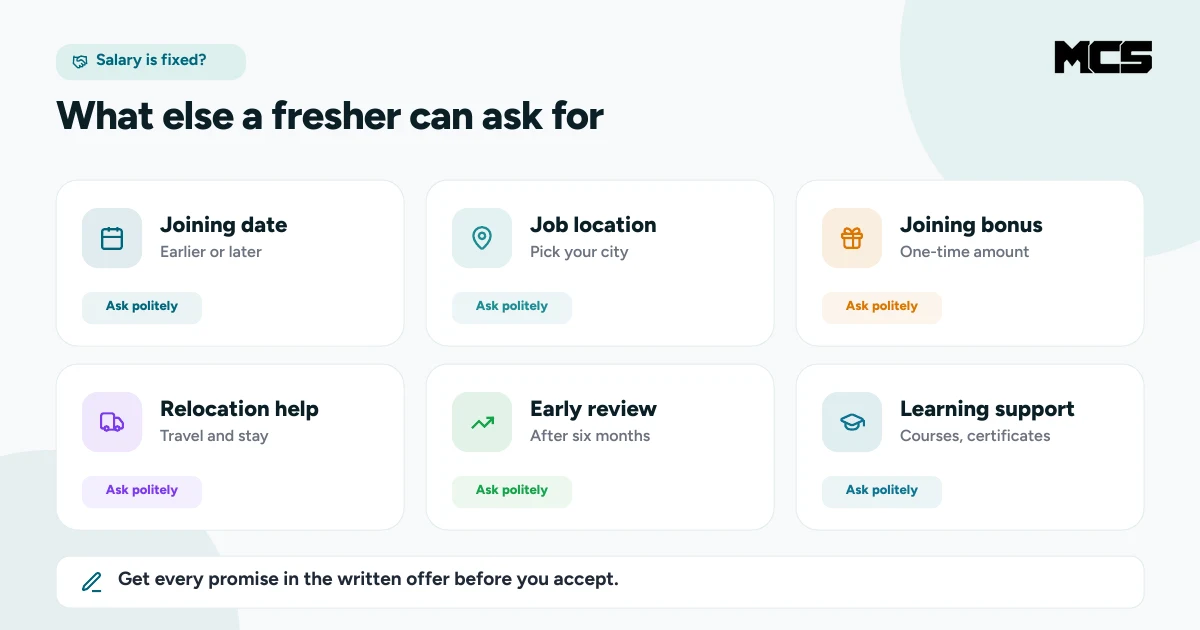
- Joining date: if you have final exams or need time to relocate, ask for a later date. If you need the job fast, ask for an earlier one.
- Job location: some companies let you choose from a few cities. Ask before accepting.
- Joining bonus: some companies give a one-time amount, especially if you need to move to a new city.
- Relocation help: travel costs, a few days of company stay or help finding accommodation.
- Early salary review: ask if your salary can be reviewed after six months based on performance, and get it in writing.
- Role or team: in smaller companies, you can sometimes ask to join the team that matches your skills best.
- Learning support: paid certifications, course fees or mentoring.
How to Negotiate Salary as a Fresher: Call Script and Email Template
Use these as a base and change the details. Keep your tone grateful and calm.
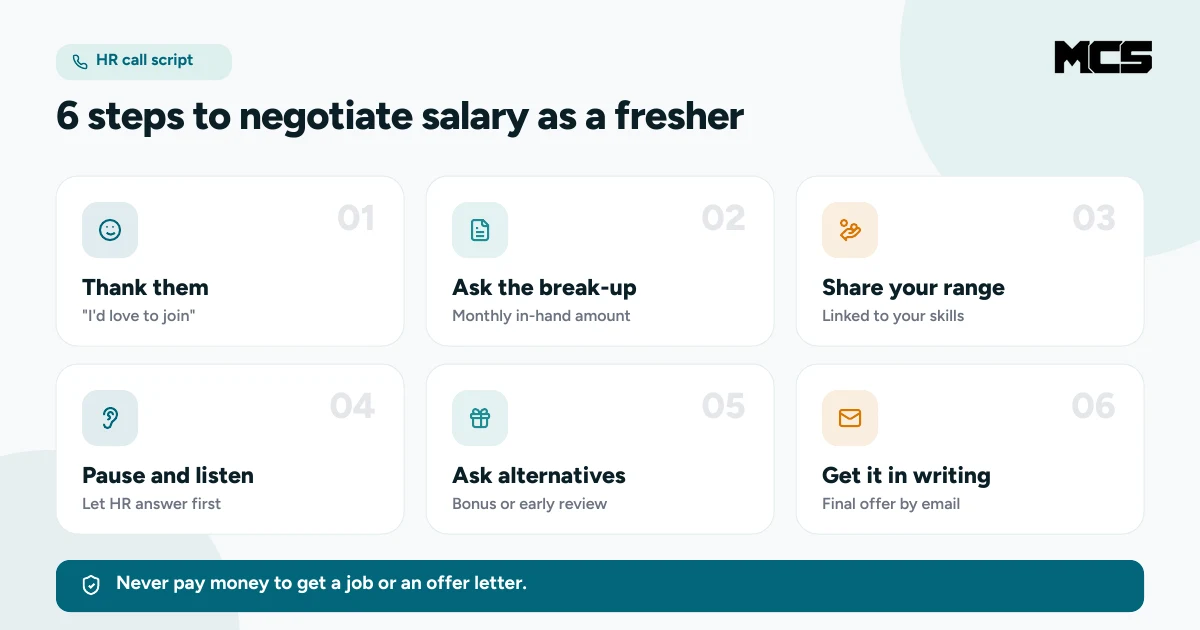
HR call script
- Thank them: "Thank you for the offer. I'm really happy and I'd love to join the team."
- Ask for the break-up: "Could you please share the salary break-up and the monthly in-hand amount?"
- Make your request: "Based on my research for this role in [city] and my [internship / project], I was hoping for around [₹X LPA]. Is there any flexibility?"
- Stay quiet and listen: let HR answer. Do not lower your own number before they respond.
- If they say no: "I understand. Could we look at a joining bonus, an early salary review after six months, or [other item]?"
- Close politely: "Thank you for checking. Could you please share the final offer by email?"
Counter-offer email template
Some people speak better in writing. An email also gives you a record.
Subject: Offer for [Role] – [Your Name]
Dear [HR name],
Thank you for the offer for the [Role] position. I am excited about the work at [Company] and would like to join.
Before I confirm, I wanted to ask about the compensation. Based on my research for similar fresher roles in [city], and my [internship at X / project Y / certification Z], I was hoping for a fixed CTC of around [₹X LPA]. If that is possible, I would be happy to confirm right away.
If the salary is fixed, I would be grateful if we could discuss a joining bonus or a salary review after six months.
Thank you for your time.
Regards,
[Your Name]
[Phone]
If you are still waiting for interview calls and not offers yet, our cold email to HR templates can help you get more interviews first.
Salary Negotiation Mistakes Freshers Make
- Saying a very low number first: the first number often becomes the anchor for the whole discussion.
- Comparing only CTC: always compare monthly in-hand pay and how much is variable.
- Lying about another offer: HR may ask for the offer letter. A false claim can end your process.
- Negotiating a fixed mass-hiring package aggressively: it rarely works and can delay your joining.
- Accepting, then negotiating: ask all your questions before you sign the offer.
- Taking only a verbal promise: get the final salary, joining bonus or review date in the written offer.
- Paying money for a job: genuine companies do not ask freshers for fees, deposits or "training charges". Treat any such request as a red flag.
6-Step Salary Negotiation Checklist for Freshers
- Find out the type of offer: mass hiring, campus fixed package, or a smaller company with a band.
- Research the salary for your role and city and set three numbers: walk-away, target and range start.
- Ask for the salary break-up and monthly in-hand amount.
- Share a polite, researched range linked to your skills, projects or internships.
- If the base is fixed, ask for joining date, location, joining bonus, relocation help or an early review.
- Get every final term in the written offer before you accept.
How My Career Solution Helps
The easiest way to get a better salary as a fresher is to have more than one interview going on at the same time. With more interviews, you are less afraid of losing one offer and can choose the best one.
My Career Solution (MCS) sends your profile and resume to recruiters at companies that match your skills. Depending on the package you choose, you get guaranteed interview calls. You also get free applications to 5 companies after you sign up and finish your profile.
- See the plans on our interview call packages page.
- Browse open jobs and companies hiring across India.
- Read more career guides on the MCS blog, such as how to answer "tell me about yourself".
FAQs
Can freshers negotiate salary in India?
Yes. In mass hiring at large IT companies the package is usually fixed, but startups, product companies and smaller firms often have a salary band. A polite, researched request based on your skills and projects is normal and rarely leads to an offer being withdrawn.
What should a fresher say when HR asks for expected salary?
Give a researched range for your role and city, for example "Based on my research for this role in Pune, I was expecting ₹X to ₹Y LPA", and link it to an internship, project or certification. If it is early in the process, say you would like to understand the role first.
How much hike can a fresher ask for over the offered salary?
There is no fixed rule. Ask for an amount that your research supports for the role and city. Asking for a small, justified increase is reasonable; asking for a number far above market rates usually is not.
Is it rude to negotiate salary as a fresher?
No, as long as you are polite, thank the company for the offer and give reasons for your request. Avoid ultimatums and do not invent other offers.
What if HR says the salary is fixed?
Accept it gracefully and ask about other parts of the offer: joining date, location, joining bonus, relocation help or a salary review after six months.
Want more interviews so you can choose the best offer? Check our interview call packages and sign up to get free applications to 5 companies.
Frequently asked questions
Can freshers negotiate salary in India?
Yes. In mass hiring at large IT companies the package is usually fixed, but startups, product companies and smaller firms often have a salary band. A polite, researched request based on your skills and projects is normal and rarely leads to an offer being withdrawn.
What should a fresher say when HR asks for expected salary?
Give a researched range for your role and city and link it to an internship, project or certification. If it is early in the process, say you would like to understand the role first.
How much hike can a fresher ask for over the offered salary?
There is no fixed rule. Ask for an amount that your research supports for the role and city. A small, justified increase is reasonable; a number far above market rates usually is not.
Is it rude to negotiate salary as a fresher?
No, as long as you are polite, thank the company for the offer and give reasons for your request. Avoid ultimatums and do not invent other offers.
What if HR says the salary is fixed?
Accept it gracefully and ask about other parts of the offer: joining date, location, joining bonus, relocation help or a salary review after six months.