Reference Check Questions for HR: 35 Questions, Call Script and Scorecard
Ankita · 6 Nov 2026 · Career & Interview Prep
Key Takeaways
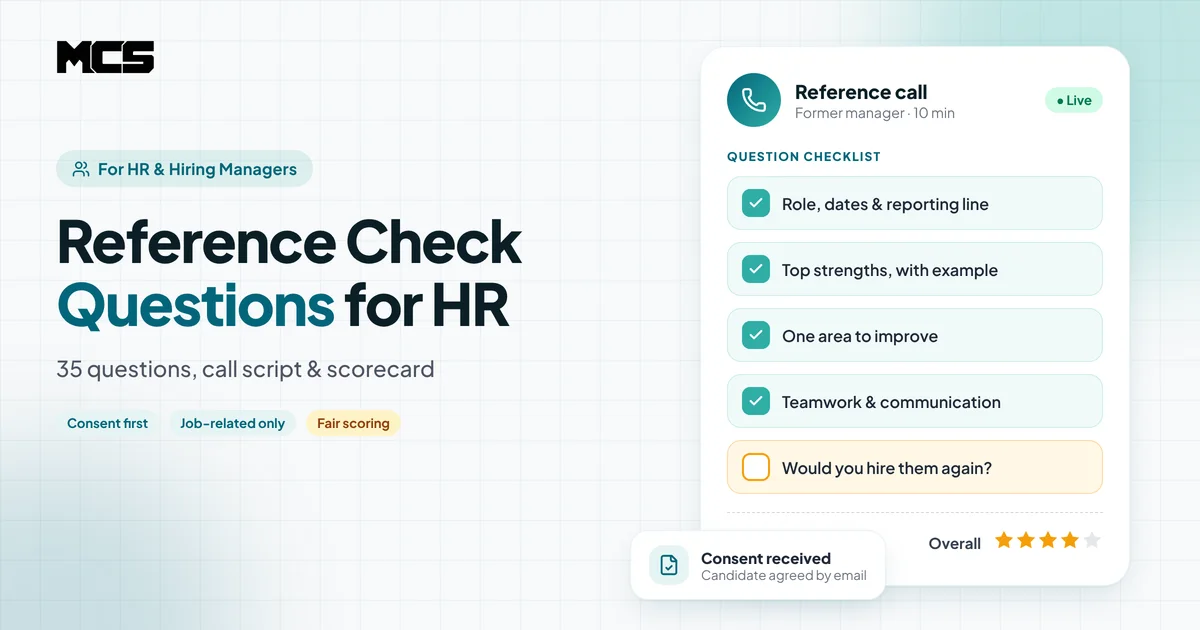
- Good reference check questions for HR are job-related and open-ended, and they are the same for every candidate in a role.
- Take the candidate's written consent before you call anyone, and tell them who you plan to contact.
- Ask about real work: role and tenure, how they did the job, how they work with people, how they handle pressure, and whether the referee would hire them again.
- Never ask about religion, caste, marital status, pregnancy, health or family plans. These have nothing to do with the job.
- Speak to at least two people, ideally a direct manager, and note answers in one simple scorecard so the decision is fair.
The best reference check questions for HR confirm facts (role, dates, reporting line), then ask how the candidate actually worked: their strengths, areas to improve, teamwork, reliability and whether the referee would hire them again. Keep every question tied to the job, take the candidate's consent first, and ask the same set for every candidate in the role.
This guide gives HR teams and hiring managers in India 35 ready-to-use reference check questions, a short call script, a list of questions to avoid, the red flags to watch for and a simple scorecard you can copy.
Table of Contents
- What Is a Reference Check (and How Is It Different from BGV)?
- When Should HR Do a Reference Check?
- How to Run a Reference Check: Step by Step
- 35 Reference Check Questions for HR
- A 10-Minute Reference Call Script
- Reference Check Questions You Should Not Ask
- Red Flags and How to Read Answers
- Reference Check Scorecard Template
- How My Career Solution Helps Employers
- FAQs
What Is a Reference Check (and How Is It Different from BGV)?
A reference check is a short conversation with people who have worked with the candidate, usually a former manager, a senior colleague or an HR contact. The goal is to hear how the person actually worked, in words from someone who saw it day to day.
It is not the same as background verification (BGV). BGV confirms facts with documents and records: employment dates, education, address and, where relevant, criminal record checks, often through a verification agency. A reference check collects opinions about performance and behaviour. Most companies in India use both: BGV for facts, reference calls for the human picture.
One practical point: many companies in India have a policy that HR will only confirm dates of employment and designation, not performance. So for performance questions, a former direct manager is usually the most useful referee.
When Should HR Do a Reference Check?
Do it at the end of the process, when you have one or two finalists, not for every applicant. That keeps the load on referees low and keeps your hiring fast. Common points to run it:
- After the final interview, before the offer: best for senior, client-facing or high-trust roles, where a poor hire is expensive.
- Along with the offer, as a condition: common for freshers and junior roles. The offer letter says it depends on satisfactory references and verification.
- When interview signals are mixed: if panels disagree, a reference call on the specific doubt (for example, ownership or communication) can settle it.
For freshers with no full-time work history, ask for a college faculty member, a project guide or an internship manager instead of a former employer.
How to Run a Reference Check: Step by Step
A reference check takes about 10-15 minutes per referee when you follow a fixed process. Here is a simple one that works for both small teams and large HR departments.
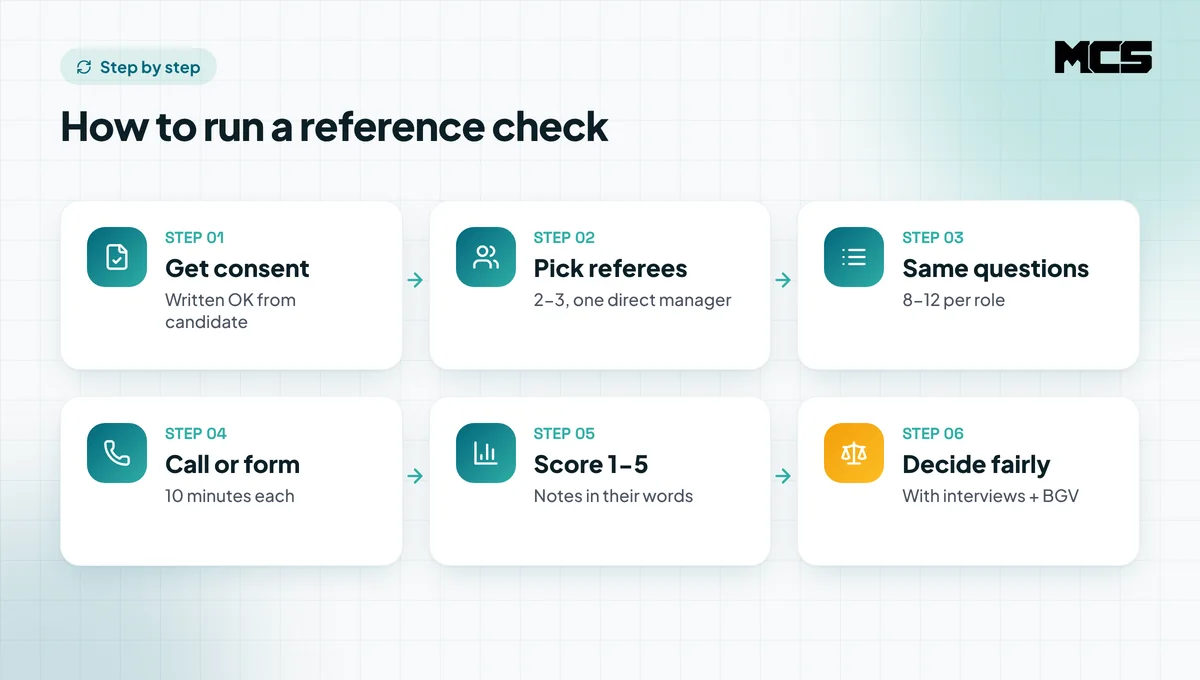
- Get written consent. Ask the candidate to agree in writing (an email or a form is fine) to the check, and tell them who you will contact and why. Under India's Digital Personal Data Protection Act, 2023, consent and purpose matter when you collect and use personal data, so check your consent wording with your legal team.
- Choose the right referees. Ask for two or three people, at least one of them a direct manager from a recent role. Check that each referee actually worked with the candidate (a quick look at LinkedIn or the company email domain helps).
- Prepare the same question set. Pick 8-12 questions from the list below that match the role. Use the same set for every finalist so you can compare fairly.
- Book a short call or send a form. A 10-minute call gives richer answers; a short online form is easier for busy referees. Many teams send the form first and call only if something needs a follow-up.
- Take notes and score. Write down answers in the referee's words, then rate each area on a simple 1-5 scale in a scorecard.
- Decide and store safely. Combine the reference result with interviews and assessments. Store notes only as long as your data policy allows, and only share them with the hiring team.
35 Reference Check Questions for HR
Pick the questions that fit the role. For a fresher or junior role, 8-10 questions are enough. For a team lead or senior hire, add the leadership set.
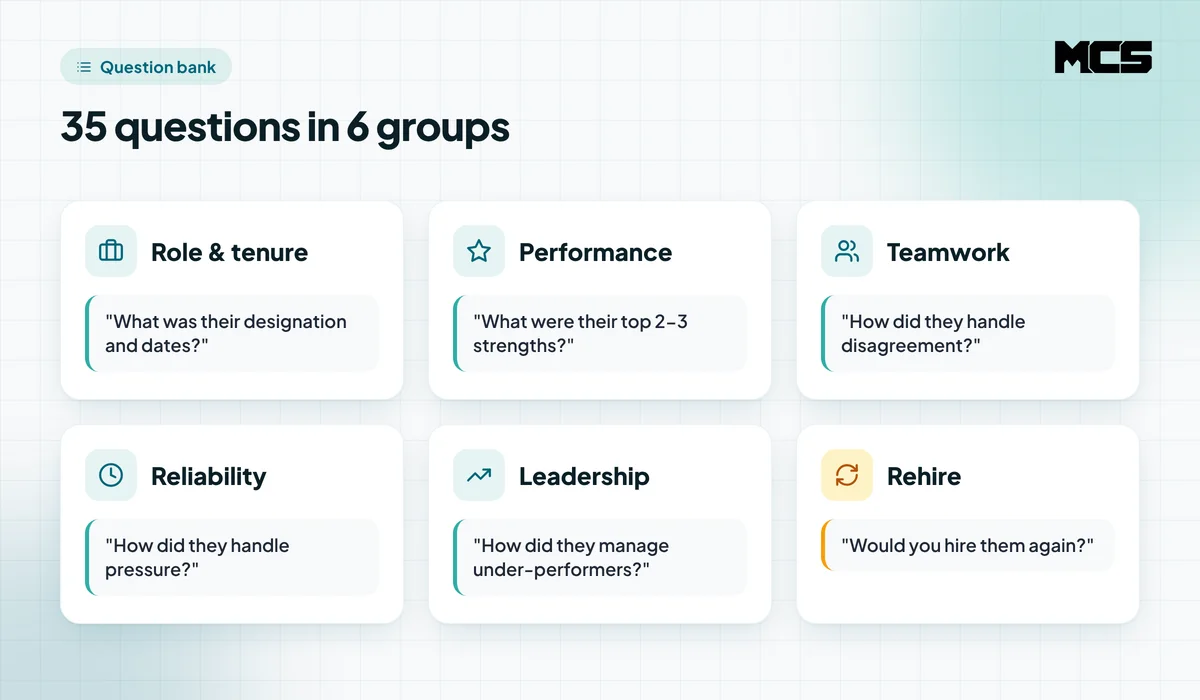
1. Relationship, role and tenure (confirm the facts)
- How do you know the candidate, and for how long did you work together?
- What was their designation, and did it change while you worked together?
- From which month and year to which month and year did they work with you?
- Who did they report to, and did anyone report to them?
- What were their main responsibilities day to day?
2. Performance and skills
- What were their two or three biggest strengths at work?
- Can you share one piece of work or project they did really well?
- Which area would you say they still need to improve in?
- How would you rate their technical or functional skills for a role like [role name], and why?
- How quickly did they learn new tools, processes or domains?
- How was the quality of their work? Did it usually need rework?
- How did they compare with others at a similar level in your team?
3. Teamwork and communication
- How did they work with teammates and other departments?
- How did they handle disagreement with a colleague or manager? Can you give an example?
- How clear was their written and spoken communication, for example in emails, updates and meetings?
- How did they respond to feedback?
- Did they work with clients or customers? How did that go?
4. Reliability and work style
- How reliable were they with deadlines and commitments?
- How did they handle pressure or a sudden change in priorities?
- Did they need close supervision, or could they work independently?
- Did they take ownership when something went wrong?
- In what kind of team or manager style do they do their best work?
5. For senior and team lead roles
- How many people did they manage, and how did the team feel about working under them?
- How did they handle an under-performing team member?
- Can you give an example of a decision they took that had a clear business impact?
- How did they plan and prioritise work for the team?
- How did they manage stakeholders above them?
- Did people from their team grow or get promoted while working with them?
6. Exit and rehire
- Why did they leave, as far as you know?
- Were there any open concerns when they left, such as handover or notice period?
- Would you hire or work with them again? Why or why not?
- If not in the same role, in which role would you rehire them?
7. Closing questions
- Is there anything about their work that I have not asked but should know?
- What advice would you give their next manager to help them succeed?
- Is there anyone else who worked closely with them that I should speak to?
Tip: questions 31 and 34 often tell you the most. A warm, specific "yes, without a doubt" is a strong signal; a long pause or a vague answer is worth a polite follow-up.
A 10-Minute Reference Call Script
Referees are busy, so keep the call short and structured. You can adapt this script:
- Opening (1 minute): "Hi, this is [your name] from [company]. [Candidate] has applied for the [role] position with us and has shared you as a reference, with their consent. Do you have about 10 minutes? Everything you share stays with our hiring team."
- Confirm facts (2 minutes): questions 1-5.
- Work and behaviour (5 minutes): 4-6 questions from sections 2-4 that matter most for the role.
- Rehire and close (2 minutes): questions 31, 33 and 34.
- Thank them: "Thank you, this is really helpful. I will not share your individual comments with the candidate."
If the referee says their company only allows HR to confirm dates, respect that, thank them and move to another referee. Do not push.
Reference Check Questions You Should Not Ask
Some questions are unfair, irrelevant to the job, and can expose your company to discrimination complaints or data-privacy issues. Keep every question about work.
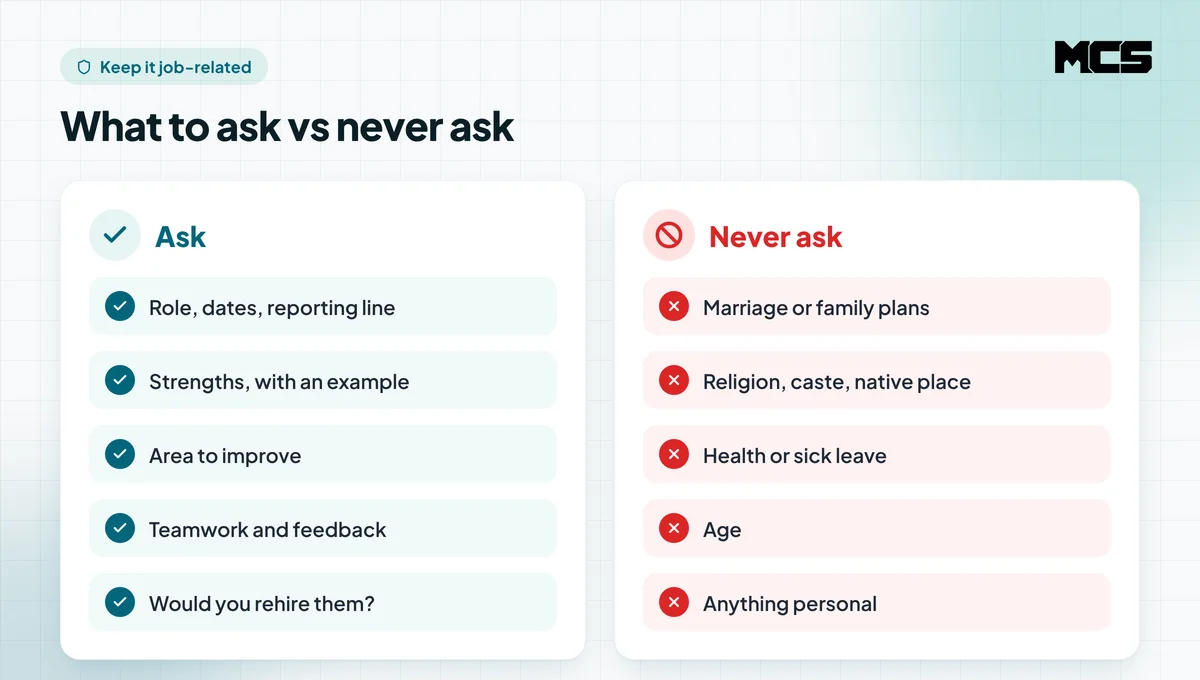
| Do not ask | Ask this instead (if relevant) |
|---|---|
| Is the candidate married? Planning a family? | Were they able to meet the shift or travel needs of the role? |
| What is their religion, caste or native place? | Nothing. This is never relevant. |
| Did they take many sick days? Any health issues? | Were they reliable with deadlines and commitments? |
| How old are they? | How much relevant experience did they gain in this role? |
| What was their exact salary? | Ask the candidate directly, and verify through BGV documents if your policy needs it. |
| Can you tell me anything personal about them? | How did they work with the team and with clients? |
Also avoid calling people the candidate did not list (for example, their current employer) without telling them and taking their consent. A surprise call can cost someone their current job.
Red Flags and How to Read Answers
One lukewarm answer is not a reason to reject a good candidate. Look for patterns across two or more referees, and compare them with what you saw in interviews.
- Facts do not match. Dates, designation or reporting line differ from the resume. Ask the candidate to explain before you decide; sometimes it is a simple title change.
- The referee is not really a manager. A "manager" who turns out to be a friend or a peer from another team gives weak evidence.
- Faint praise. "They were fine" or "no complaints" with no example. Ask, "Can you share one thing they did well?"
- Hesitation on rehire. A pause or "it depends" on question 31 deserves a gentle follow-up: "Depends on what?"
- The same concern twice. If two referees separately mention the same weak area, take it seriously and check it in your onboarding plan or a final conversation.
- Exit issues. Incomplete handover, notice period disputes or unclear exit reasons need a direct, respectful question to the candidate.
If you also want to tighten screening earlier in the funnel, read our guide on HR interview questions for freshers, which shows what good answers look like from the candidate's side.
Reference Check Scorecard Template
A scorecard turns notes into a fair comparison between finalists. Copy this into a sheet and fill one row per referee.
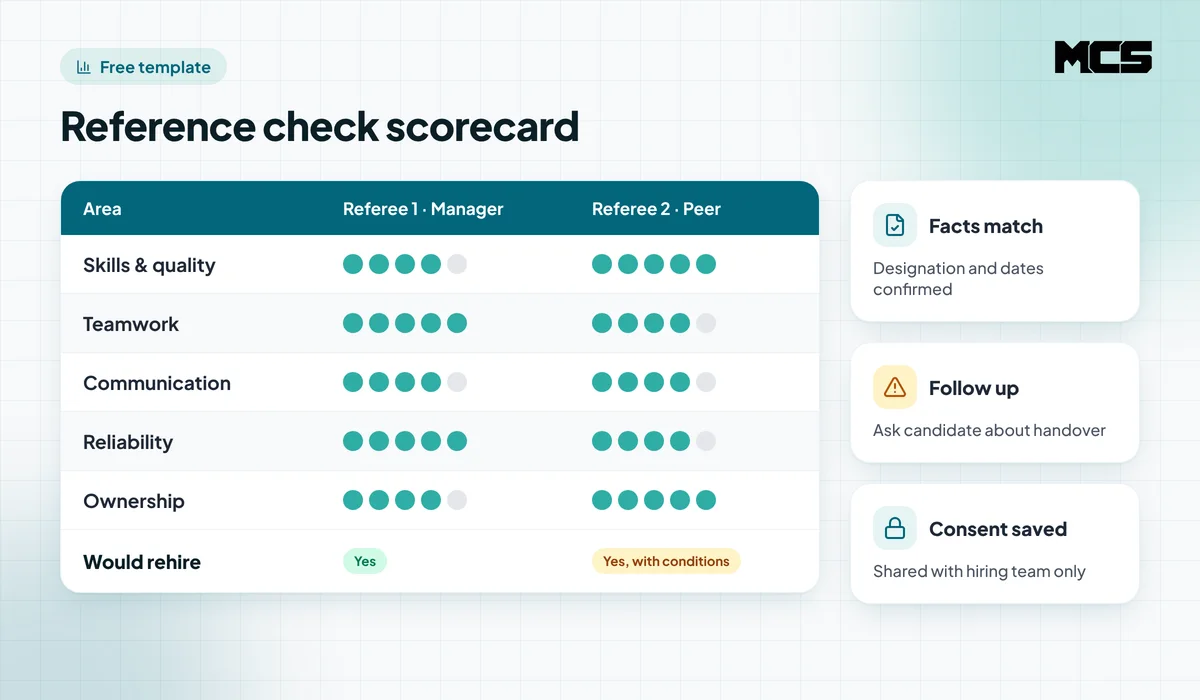
| Field | What to write |
|---|---|
| Candidate and role | Name, role applied for, date of check |
| Referee | Name, designation, company, relationship (manager, peer, faculty) |
| Facts confirmed | Designation and dates: match / mismatch (note the difference) |
| Skills and quality of work | 1-5, plus one example in the referee's words |
| Teamwork and communication | 1-5, plus one example |
| Reliability and ownership | 1-5, plus one example |
| Would rehire | Yes / Yes with conditions / No |
| Concerns to follow up | Any point to discuss with the candidate |
| Checked by and consent | Your name; link to the candidate's consent |
Before you even reach references, a clean resume shortlist saves time. Our post on ATS-friendly resumes for freshers explains what a well-built fresher resume looks like, and the software developer fresher resume format shows what to expect from tech applicants.
How My Career Solution Helps Employers
My Career Solution works with job seekers across India, mainly in IT, product and MNC roles, and gives HR teams a free employer account. Inside the employer portal you can:
- Request reference feedback in a few clicks: open a candidate, send reference requests to HR at their previous companies, and the referee fills a short online form (overall rating, would they rehire, role, tenure, strengths and areas to improve). The answers come back to your dashboard, and the candidate is told that a reference check was requested.
- See candidates sent to you: profiles that MCS has already matched and sent to your company.
- Search candidates by role or skill and message them from the portal.
- Post a job and schedule meetings with shortlisted candidates in one place.
You can create a free employer account or log in to the employer portal. To see which companies are active on MCS, browse companies hiring now or the latest jobs. For more hiring and career guides, visit the MCS blog.
If you are a job seeker reading this, the same rules apply in reverse: keep two or three referees ready, tell them in advance, and make sure your resume dates match your records. MCS can help you get interview calls; see our packages.
FAQs
What questions should HR ask in a reference check?
Start by confirming the referee's relationship, the candidate's designation, dates and reporting line. Then ask about strengths, an area to improve, teamwork, communication, reliability under pressure and whether the referee would hire them again. Keep every question job-related and use the same set for every candidate.
Is candidate consent needed for a reference check in India?
Yes, take written consent before contacting referees and tell the candidate who you will contact and why. India's Digital Personal Data Protection Act, 2023 puts weight on consent and purpose when you process personal data, so confirm your consent wording and data retention with your legal team.
How many references should HR check?
Two or three is common. Try to include at least one direct manager from a recent role. For freshers, a project guide, faculty member or internship manager works well.
Can a previous employer refuse to give a reference?
Yes. Many companies in India only confirm designation and dates of employment as a policy. Respect it, and ask the candidate for another referee who worked with them closely.
What is the difference between a reference check and background verification?
A reference check collects opinions about how the candidate worked, from people who saw their work. Background verification confirms facts such as employment dates, education and address using documents and records, often through an agency.
Frequently asked questions
What questions should HR ask in a reference check?
Start by confirming the referee's relationship, the candidate's designation, dates and reporting line. Then ask about strengths, an area to improve, teamwork, communication, reliability under pressure and whether the referee would hire them again. Keep every question job-related and use the same set for every candidate.
Is candidate consent needed for a reference check in India?
Yes, take written consent before contacting referees and tell the candidate who you will contact and why. India's Digital Personal Data Protection Act, 2023 puts weight on consent and purpose when you process personal data, so confirm your consent wording and data retention with your legal team.
How many references should HR check?
Two or three is common. Try to include at least one direct manager from a recent role. For freshers, a project guide, faculty member or internship manager works well.
Can a previous employer refuse to give a reference?
Yes. Many companies in India only confirm designation and dates of employment as a policy. Respect it, and ask the candidate for another referee who worked with them closely.
What is the difference between a reference check and background verification?
A reference check collects opinions about how the candidate worked, from people who saw their work. Background verification confirms facts such as employment dates, education and address using documents and records, often through an agency.