How Many Jobs to Apply Per Day to Get Interviews: Daily Targets, Routine and Tracker
Ankita · 5 Nov 2026 · Career & Interview Prep
Key Takeaways
- There is no magic number, but a good daily target is 5-10 well-matched applications for freshers, 4-6 for people with 1-3 years of experience and 2-4 highly tailored ones (plus referrals) for 4-8 years of experience.
- More is not always better. Job-search tracking data shows the interview rate per application drops when people mass-apply to roles that only loosely fit them.
- Apply early (ideally within 1-2 days of a job being posted), use a resume tailored to the job's keywords and follow up once after about a week.
- Spend about 90 minutes a day on a fixed routine: find jobs, tailor and apply, reach out to HR or alumni, then track and follow up.
- Review your numbers every week. If 40-50 applications bring zero calls, the problem is your resume or targeting, not the count. Fix that before you apply more.
How many jobs should you apply to per day to get interviews? For most Indian freshers, 5-10 targeted applications a day is the sweet spot; for experienced professionals, 2-6 tailored applications a day plus referrals works better than mass applying. The real goal is not the count but how many of those applications turn into interview calls.
This guide gives you a daily target by experience level, explains why quality beats quantity, and shares a simple 90-minute daily routine and tracker so you can see what is working. It is written for job seekers in India applying for IT, tech, product and MNC roles, but the same method works for most office jobs.
Table of Contents
- How many jobs to apply per day: the short answer
- Daily application target by experience level
- Quality vs quantity: why mass applying backfires
- What makes one application count
- A 90-minute daily job application routine
- Track your applications and fix the weak step
- Common mistakes that waste applications
- How My Career Solution helps
- FAQs
How Many Jobs to Apply Per Day: The Short Answer
Most career guides and recruiters land on the same advice: send a steady number of good applications every day instead of a big burst once a week. Suggested numbers range from about 2-5 applications a day for a careful, tailored search to 10-15 a day on job portals for freshers. That is a wide range, so here is a simple way to decide your number.
- Count only jobs you actually fit. If you match most of the must-have skills and the experience range, it counts. If you match two out of eight requirements, it does not.
- Your daily number depends on how many fresh, relevant openings appear. A Java fresher in Bangalore or Pune will find more new openings per day than a niche SAP consultant in a smaller city.
- Consistency beats spikes. Applying to 7 jobs every weekday (35 a week) usually works better than 60 applications on one Sunday, because you catch jobs while they are new and you have time to follow up.
If you are not sure where to start, begin with the targets in the next section, run them for two weeks, and adjust based on how many interview calls you get.
Daily Application Target by Experience Level
Your experience changes both how many jobs fit you and how much effort each application needs. Freshers can apply to more roles because entry-level openings are many and requirements are broad. Experienced people get better results from fewer, sharper applications and referrals.
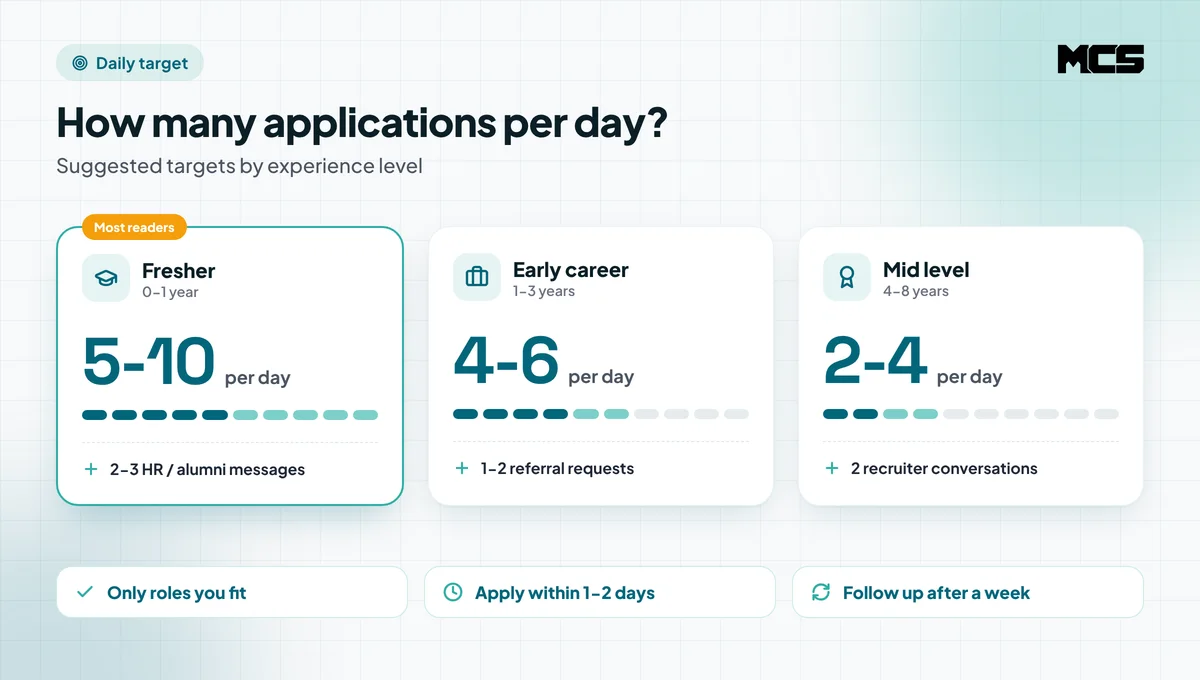
| Profile | Suggested applications per day | Per week (5 days) | Extra daily action |
|---|---|---|---|
| Fresher (0-1 year) | 5-10 targeted | 25-50 | 2-3 messages to HR, alumni or seniors |
| Early career (1-3 years) | 4-6 tailored | 20-30 | 1-2 referral requests |
| Mid level (4-8 years) | 2-4 highly tailored | 10-20 | 2 referral or recruiter conversations |
| Career switcher | 3-5 tailored | 15-25 | 1 portfolio or project update per week |
These are working targets, not rules. If you are serving a notice period, aim at the higher end so interviews line up with your last working day. If you are still in college, 3-5 a day around your classes is enough while you build projects and prepare for off-campus drives.
Not sure which roles fit you best? Read our guide on how to find the right job based on your skills before you set your daily number.
Quality vs Quantity: Why Mass Applying Backfires
Many job seekers try to "win by volume": 50-100 one-click applications a day with the same resume. It feels productive, but it usually leads to fewer interviews, not more. Job-search tracking data published in 2026 (Huntr's data, as reported by Scoutify) showed that the interview rate per application falls sharply for people who send very large numbers of applications compared with those who send a moderate number.
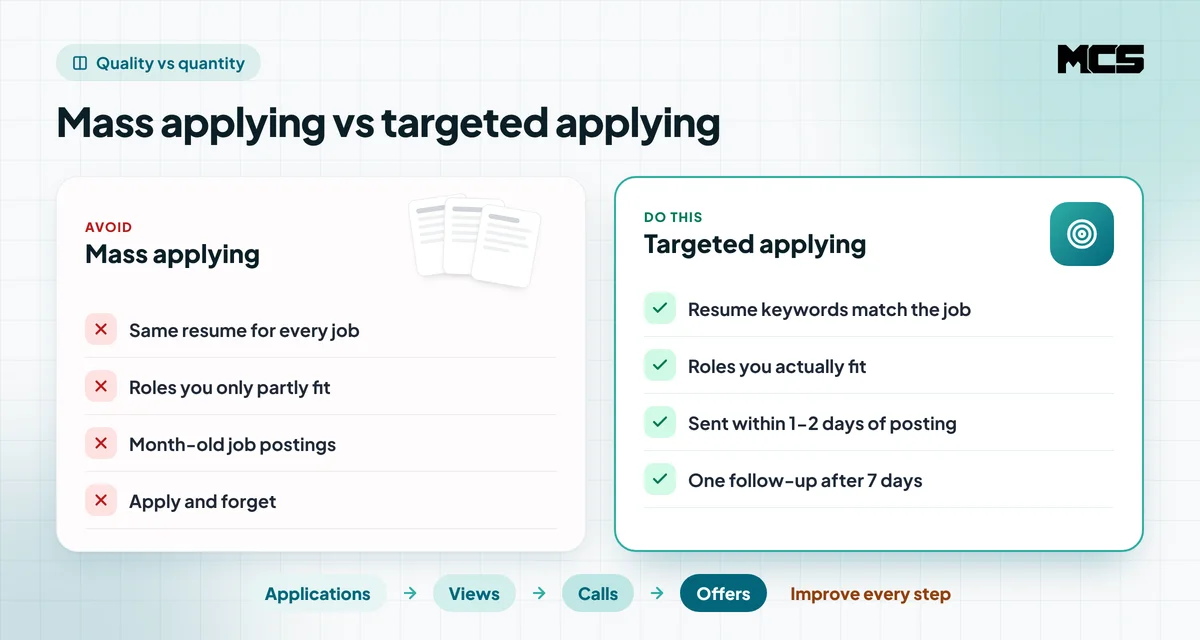
Here is why volume alone fails:
- ATS filters are keyword-based. Most companies use an applicant tracking system. A generic resume misses the role's keywords, so it ranks low even if you could do the job. See our ATS friendly resume guide to fix this.
- You apply to roles you do not fit. When the goal is a big number, people start applying to jobs that need 5 years of experience or a different stack. Those applications almost never convert.
- No time for follow-up. Recruiters respond to people who show genuine interest. If all your time goes into clicking "Apply", nothing is left for a short follow-up email or a referral request.
- Burnout. Mass applying with no replies is tiring and hurts confidence before interviews even start.
The better approach is a moderate daily number where every application is relevant, tailored and sent early. Think of it as a funnel: applications lead to views, views lead to calls, calls lead to offers. Improving each step matters more than stuffing the top of the funnel.
What Makes One Application Count?
Before you raise your daily number, make each application stronger. A good application has five parts:
- Right fit: you match most of the must-have skills and the experience range in the job description.
- Tailored resume: your summary and skills section use the same words as the job post (for example "Spring Boot" and "REST APIs", not just "Java"). Keep one master resume and make a quick copy for each role family.
- Sent early: recruiters often start shortlisting within the first few days of a posting. Filter job portals by "last 24 hours" or "last 3 days".
- Direct contact: where possible, also email the HR or recruiter. Use one of our cold email to HR templates.
- Visible profile: recruiters often check your LinkedIn after they see your application. Follow these LinkedIn profile tips for freshers.
Freshers should also make sure their resume layout is clean and project-focused. Our resume format for software developer freshers shows exactly what to include.
A 90-Minute Daily Job Application Routine
A fixed routine makes it easy to hit your daily number without spending the whole day on job portals. Here is a routine that fits around college, a current job or interview preparation.
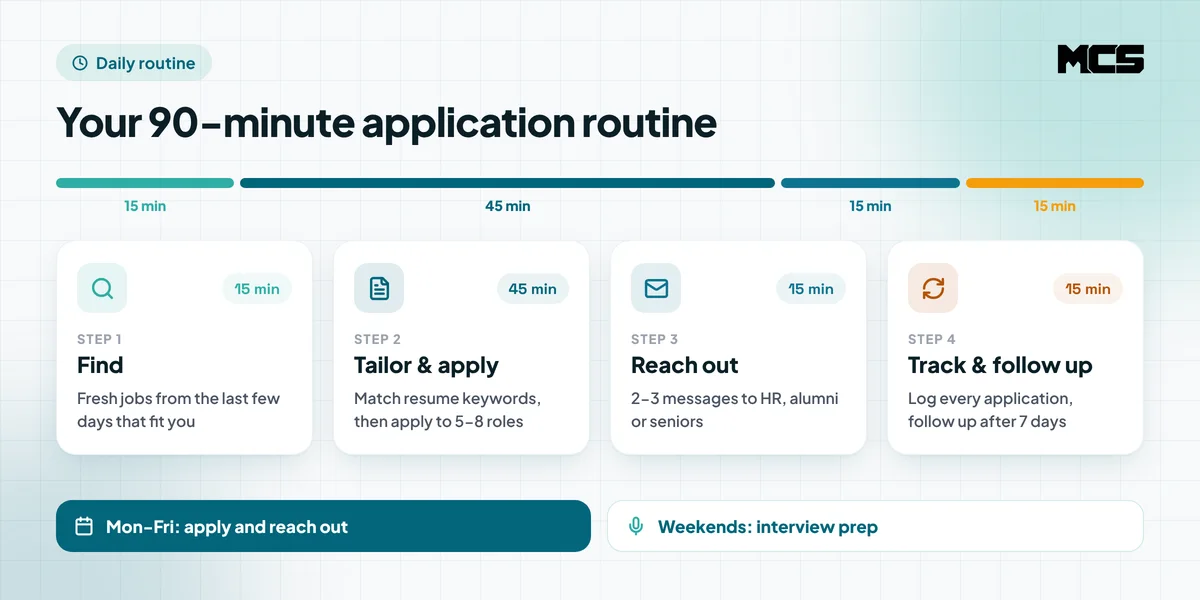
- Find (15 minutes): check saved searches and job alerts on 2-3 sources, such as a job portal, LinkedIn and company career pages. Shortlist only roles posted in the last few days that you fit. You can also browse fresh openings on MCS Jobs and companies hiring now on MCS Companies.
- Tailor and apply (45 minutes): for each shortlisted job, adjust your resume summary and top skills to match the job's keywords, then apply. With a master resume ready, this takes about 5-8 minutes per job, which gives you 5-8 good applications.
- Reach out (15 minutes): send 2-3 short messages: a cold email to HR for your best-fit role, a referral request to a senior or alumni, or a connection note to a recruiter.
- Track and follow up (15 minutes): log every application in a tracker and send one polite follow-up for applications that are about 7 days old with no reply.
Do this on weekdays. Use the weekend for interview preparation, such as practising HR interview questions for freshers and your "tell me about yourself" answer, and for one bigger task like a new project or resume update.
Track Your Applications and Fix the Weak Step
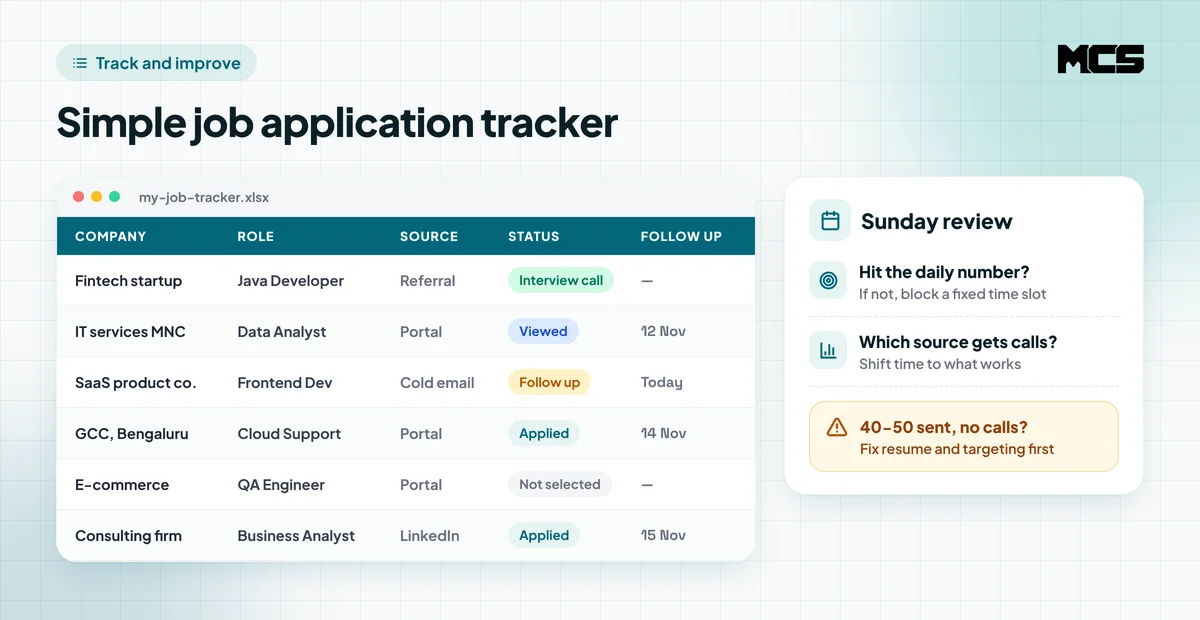
The only reliable way to know if your daily number is right is to track it. A simple spreadsheet is enough. Use these columns: date, company, role, source (portal, referral, cold email), resume version, status (applied, viewed, call, interview, rejected) and follow-up date.
Every Sunday, look at the last 7 days and ask three questions:
- Did I hit my daily number? If not, the issue is routine, not strategy. Block a fixed time slot.
- How many applications turned into calls? If you sent 40-50 relevant applications over two weeks and got no calls at all, do not apply more. Fix your resume keywords, your target roles or your experience range first. Our guide on why you are not getting interview calls lists the usual reasons.
- Which source works best? If referrals and cold emails bring calls but portal applications do not, shift more of your 90 minutes to outreach.
Once calls start coming, you can raise your daily number slightly, because now you know each application has a fair chance.
Common Mistakes That Waste Applications
- Using one resume for every role: a data analyst job and a Java developer job need different summaries and skills.
- Applying to old postings: a job posted a month ago may already be in final rounds. Prefer fresh posts.
- Ignoring the experience range: freshers applying to "3-5 years" roles rarely get shortlisted. Focus on 0-1 or 0-2 year roles.
- Applying and forgetting: no tracker means no follow-up and no way to learn what works.
- Paying anyone just to "apply" for you without clear terms: genuine services explain exactly what they do, how many companies they reach and what happens if you do not get calls. Never pay a "company" that asks for a fee to give you a job offer.
- Applying in bursts: 100 applications in one weekend and then nothing for two weeks gives you no rhythm and no follow-ups.
How My Career Solution Helps
Hitting a daily target while also preparing for interviews is hard, especially if you are working or studying. My Career Solution takes the application work off your plate:
- Free start: when you sign up and complete your profile, you can apply free to 5 companies from your dashboard.
- Guaranteed interview calls: MCS packages apply on your behalf to companies that match your profile and come with guaranteed interview calls based on the package you choose. See the details on the packages page.
- Fresh openings: browse live openings on MCS Jobs and see who is hiring on MCS Companies.
- Real feedback: read what other job seekers say on our reviews page.
You can keep your own daily routine for referrals and interview prep, while MCS handles a steady flow of applications in the background. For more job-search guides, visit the MCS blog or start with our pillar guide on how to get interview calls for freshers.
FAQs
How many jobs should I apply to per day as a fresher?
Around 5-10 targeted applications a day works well for most freshers, as long as you fit the role and tailor your resume keywords. Add 2-3 messages to HR, alumni or seniors each day for better results.
Is applying to 50 jobs a day a good idea?
Usually not. At that volume most applications go to roles you only partly fit, with a generic resume and no follow-up, so the interview rate per application drops. A smaller number of well-matched, tailored applications sent early tends to bring more calls.
How many applications does it take to get an interview?
It varies a lot by role, city, experience and resume quality, so there is no fixed number. Track your own numbers: if 40-50 relevant applications bring no calls, fix your resume and targeting before applying more.
What is the best time to apply for jobs?
Apply as soon as you can after a job is posted, ideally within 1-2 days, because recruiters often start shortlisting early. Set job alerts and check them every morning.
Should I apply to jobs on weekends?
You can, but a weekday routine is easier to keep and lines up with when most recruiters are active. Use weekends for interview preparation, projects and updating your resume.
Ready to get more interview calls without spending hours on job portals? Sign up on My Career Solution to apply free to 5 companies, or check the MCS packages for guaranteed interview calls.
Frequently asked questions
How many jobs should I apply to per day as a fresher?
Around 5-10 targeted applications a day works well for most freshers, as long as you fit the role and tailor your resume keywords. Add 2-3 messages to HR, alumni or seniors each day for better results.
Is applying to 50 jobs a day a good idea?
Usually not. At that volume most applications go to roles you only partly fit, with a generic resume and no follow-up, so the interview rate per application drops. A smaller number of well-matched, tailored applications sent early tends to bring more calls.
How many applications does it take to get an interview?
It varies a lot by role, city, experience and resume quality, so there is no fixed number. Track your own numbers: if 40-50 relevant applications bring no calls, fix your resume and targeting before applying more.
What is the best time to apply for jobs?
Apply as soon as you can after a job is posted, ideally within 1-2 days, because recruiters often start shortlisting early. Set job alerts and check them every morning.
Should I apply to jobs on weekends?
You can, but a weekday routine is easier to keep and lines up with when most recruiters are active. Use weekends for interview preparation, projects and updating your resume.